


2026 New JN0-351 Dumps - Real Juniper Exam Questions
Dependable JN0-351 Exam Dumps to Become Juniper Certified
Juniper JN0-351 Exam Syllabus Topics:
| Topic | Details |
|---|---|
| Topic 1 |
|
| Topic 2 |
|
| Topic 3 |
|
| Topic 4 |
|
NEW QUESTION # 24
Which two statements are correct about martian routes? (Choose two.)
- A. Martian routes are always host addresses.
- B. Martian routes only represent publicly used prefixes.
- C. Martian routes are never installed in the route table.
- D. Additional prefixes can be added to the list of martian routes.
Answer: C,D
Explanation:
Martian routes are never installed in the route table.
Martian routes refer to IP addresses or prefixes that are considered invalid or reserved, and they are not installed in the routing table.
Additional prefixes can be added to the list of martian routes.
Network administrators can configure the system to treat additional prefixes as Martian routes based on specific network policies or requirements.
NEW QUESTION # 25
You have deployed a Juniper EX Series switch in the network. The switch receives a unicast frame destined to a MAC address that is not registered in the bridging table.
Which statement describes the behavior of the switch?
- A. The frame is flooded out all ports in all VLANs configured on the switch.
- B. The switch sends an error message to the sender declaring that the host is unreachable.
- C. The switch performs an ARP request to discover the MAC address of the destination host.
- D. The frame is flooded out all ports that are part of the same VLAN, except the receiving port.
Answer: D
Explanation:
According to the Juniper documentation1, when a switch receives a unicast frame destined to a MAC address that is not registered in the bridging table, it floods the frame out all ports that are part of the same VLAN, except the receiving port. This is the default behavior of a switch when it does not know the destination MAC address. The switch does not perform an ARP request, send an error message, or flood the frame to all VLANs. References: Understanding Unicast Flooding | Junos OS | Juniper Networks
NEW QUESTION # 26
Click the Exhibit button.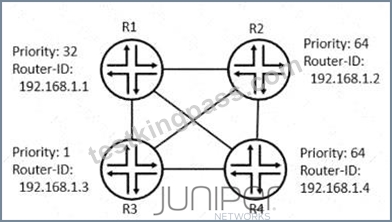
R1 was started at 4:00 PM. R2 and R3 were started at 6:00 PM. R4 was started at 10:00 PM. All routers are in Area 0 and there are no point-to-point links.
Referring to the exhibit, which router is the designated router?
- A. R2
- B. R4
- C. R1
- D. R3
Answer: B
NEW QUESTION # 27
A new network requires multiple topology support. You decide to use IS-IS in this situation. Which three protocol topologies are supported in this scenario? (Choose three.)
- A. multicast
- B. IPv4
- C. anycast
- D. IPv6
- E. IPsec
Answer: A,B,D
Explanation:
IS-IS (Intermediate System to Intermediate System) is a routing protocol that is designed to move information efficiently within a computer network 1 2 . It supports multiple protocol topologies, including IPv4, IPv6, and multicast 1 2 . Therefore, options C, E, and D are correct.
NEW QUESTION # 28
Which statement correctly describes the purpose of Bidirectional Forwarding Detection (BFD) in Junos OS?
- A. BFD provides rapid failure detection for a link or path between two adjacent devices, independent of the routing protocol in use.
- B. BFD can only be used with static routes.
- C. BFD replaces the need for a routing protocol's own hello mechanism entirely.
- D. BFD is a routing protocol used to exchange prefix information.
Answer: A
Explanation:
Bidirectional Forwarding Detection (BFD) is a lightweight protocol used to rapidly detect failures in the forwarding path between two adjacent devices, typically much faster than a routing protocol's native hello/dead timer mechanism. BFD can be associated with multiple routing protocols, such as OSPF, BGP, and static routes, to trigger faster reconvergence upon detecting a failure.
NEW QUESTION # 29
Which two statements about BGP facilitate the prevention of routing loops within an autonomous system?
(Choose two.)
- A. Routes learned from IBGP neighbors are only advertised to other IBGP neighbors.
- B. IBGP sessions must be configured as a physical full mesh.
- C. Routes learned from IBGP neighbors are not readvertised to other IBGP neighbors.
- D. IBGP sessions must be configured as a logical full mesh.
Answer: C,D
Explanation:
BGP has a simple loop prevention mechanism for eBGP that checks the AS path for its own AS number.
However, this mechanism does not work for iBGP, since all routers in the same AS have the same AS number. Therefore, iBGP has two additional rules to prevent routing loops within an autonomous system:
A router does not advertise a route learned from an iBGP neighbor to another iBGP neighbor. This rule ensures that a route does not loop back to the original iBGP router through another iBGP path.
A router does not accept a route learned from an iBGP neighbor if the next hop is not reachable via an IGP.
This rule ensures that a router does not forward packets to an unreachable next hop.
These two rules imply that iBGP sessions must be configured as a logical full mesh, meaning that every iBGP router must have a direct iBGP session with every other iBGP router in the same AS. This way, every iBGP router can learn the best route from the eBGP routers and use the IGP to reach the next hop. A logical full mesh does not require a physical full mesh, meaning that iBGP routers do not have to be directly connected.
They can use intermediate routers to establish iBGP sessions, as long as the IGP can reach the next hop.
A logical full mesh can be challenging to scale and maintain, especially for large ASes with many iBGP routers. Therefore, some alternatives to the full mesh requirement have been developed, such as route reflectors and confederations. These alternatives relax the iBGP rules and introduce additional attributes and mechanisms to prevent routing loops, such as originator ID and cluster list. References:
BGP Fundamentals
BGP - eBGP loop prevention mechanism same AS number
Loop Prevention in BGP Routing
NEW QUESTION # 30
After receiving a BGP route, which two conditions are verified by the receiving router to ensure that the received route is valid? (Choose two)
- A. The loops do not exist.
- B. The AS-path length is greater than 0.
- C. The next hop is reachable.
- D. The local preference is greater than 0.
Answer: A,C
Explanation:
B is correct because the loops do not exist is one of the conditions that are verified by the receiving router to ensure that the received BGP route is valid. A loop in BGP means that a route has been advertised by the same AS more than once, which can cause routing instability and inefficiency. To prevent loops, BGP uses the AS-path attribute, which lists the AS numbers that a route has traversed from the origin to the destination. The receiving router checks the AS-path attribute of the received route and discards it if it finds its own AS number in the list. This way, BGP avoids accepting routes that contain loops.
C is correct because the next hop is reachable is one of the conditions that are verified by the receiving router to ensure that the received BGP route is valid. The next hop is the IP address of the next router that is used to forward packets to the destination network. The receiving router checks the next hop attribute of the received route and verifies that it has a valid route to reach it.
If the next hop is not reachable, the received route is not usable and is rejected by the receiving router. This way, BGP ensures that only feasible routes are accepted.
NEW QUESTION # 31
Which two statements are correct about BGP confederations? (Choose two.)
- A. Routers within different sub-autonomous systems in the same confederation use eBGP-like sessions called confederation eBGP.
- B. Confederations require a route reflector to function.
- C. A confederation divides a single AS into multiple sub-autonomous systems.
- D. The confederation appears as a single AS to external peers.
Answer: A,C,D
Explanation:
Wait, only two are requested.
Explanation:
A BGP confederation divides a large autonomous system into smaller sub-autonomous systems to reduce iBGP mesh complexity, while still appearing as a single AS number to external peers outside the confederation. Peering between routers in different sub-ASes within the confederation uses a modified eBGP session type (confederation eBGP), which preserves certain iBGP-like attributes such as next-hop and local preference.
NEW QUESTION # 32
You are receiving the BGP route shown in the exhibit from four different upstream ISPs.
Referring to the exhibit, which ISP will be selected as the active path?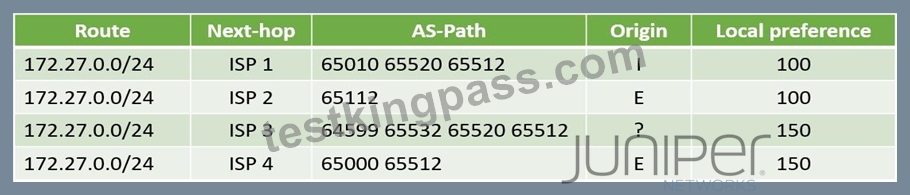
- A. ISP 3
- B. ISP 1
- C. ISP 4
- D. ISP 2
Answer: C
Explanation:
In BGP, the path selection process is based on a set of attributes. The process starts by preferring the path with the highest weight, then the highest local preference, then the locally originated routes, and so on. If all these attributes are the same, then it prefers the path with the shortest AS path.
Referring to the exhibit, all four ISPs have the same weight, local preference, and origin.
However, ISP 4 has the shortest AS path. Therefore, ISP 4 will be selected as the active path.
So, option C is correct.
NEW QUESTION # 33
Which statement about the default action of MAC limiting is true when the number of MAC addresses has hit the limit set?
- A. The switch will shut down the offending port for five minutes.
- B. The switch stops learning MAC addresses on the offending port, and any traffic to or from the offending MAC address will be dropped.
- C. The switch will shut down MAC learning on the offending port for five minutes.
- D. The switch stops learning MAC addresses on the offending port, but floods traffic out of all ports for the offending MAC address.
Answer: B
NEW QUESTION # 34
Which two statements correctly describe RSTP port roles? (Choose two.)
- A. The backup port is used as a backup for the root port.
- B. The alternate port is a standby port for an edge port.
- C. The root port is responsible for forwarding data to the root bridge.
- D. The designated port forwards data to the downstream network segment or device.
Answer: C,D
Explanation:
In Rapid Spanning Tree Protocol (RSTP), there are several port roles that determine the behavior of the port in the spanning tree 1 .
Option A suggests that the designated port forwards data to the downstream network segment or device. This is correct because the designated port is the port on a network segment that has the best path to the root bridge
1 . It's responsible for forwarding frames towards the root bridge and sending configuration messages into its segment 1 .
Option D suggests that the root port is responsible for forwarding data to the root bridge. This is also correct because the root port is always the link directly connected to the root bridge, or the shortest path to the root bridge 1 . It's used to forward traffic towards the root bridge 1 .
Therefore, options A and D are correct.
NEW QUESTION # 35
Which two statements are true about the default VLAN on Juniper switches? (Choose two.)
- A. The default VLAN ID is not visible.
- B. The default VLAN is set to a VLAN ID of 1 by default
- C. The default VLAN ID can be changed.
- D. The default VLAN ID is not assigned to any interface.
Answer: B,C
Explanation:
On Juniper switches, the default VLAN is set to a VLAN ID of 1 by default. This means that all interfaces on the switch are members of VLAN until they are specifically assigned to another VLAN. Therefore, option A is correct.
The default VLAN ID can be changed. This allows network administrators to configure the switch to use a different VLAN as the default, if necessary. Therefore, option D is correct.
NEW QUESTION # 36
Which two statements are correct about IS-IS? (Choose two.)
- A. IS-IS only allows you to configure two areas.
- B. IS-IS uses IPv6 as its transport protocol in the Junos OS implementation.
- C. IS-IS has two metric types and Junos sends both by default.
- D. IS-IS sends a maximum metric value of 63 by default.
Answer: C,D
NEW QUESTION # 37
What is the default keepalive time for BGP?
- A. 90 seconds
- B. 10 seconds
- C. 60 seconds
- D. 30 seconds
Answer: D
Explanation:
The default hold-time is 90 seconds, meaning that the default frequency for keepalive messages is 30 seconds.
https://www.juniper.net/documentation/us/en/software/junos/bgp/topics/ref/statement/precision- timers-edit-protocols- bgp.html#:~:text=BGP%20on%20the%20local%20routing,keepalive%20messages%20is%2030
%20seconds
NEW QUESTION # 38
Which statement is correct about the IS-IS ISO NET address?
- A. An ISO NET address defined with a system ID of 0000.0000.0000 must be selected as the DIS.
- B. The Area ID must match on all devices within a L2 area.
- C. An ISO NET address must be unique for each device in the network.
- D. You can only define a single ISO NET address per device.
Answer: C
Explanation:
An ISO NET address is a type of network address used by the IS-IS routing protocol. It identifies a point of connection to the network, such as a router interface, and is also called a Network Service Access Point (NSAP)1.
An ISO NET address consists of three parts: an area ID, a system ID, and a selector2. The area ID identifies the IS-IS area to which the device belongs. The system ID uniquely identifies the device within the area. The selector identifies a specific service or function on the device, such as routing or management2.
An ISO NET address must be unique for each device in the network, because it is used by IS-IS to establish adjacencies, exchange routing information, and compute shortest paths2. If two devices have the same ISO NET address, they will not be able to communicate with each other or with other devices in the network. Therefore, it is important to assign different ISO NET addresses to each device in the network.
NEW QUESTION # 39
Referring to the exhibit, Router-1 and Router-2 are failing to form an IS-IS adjacency.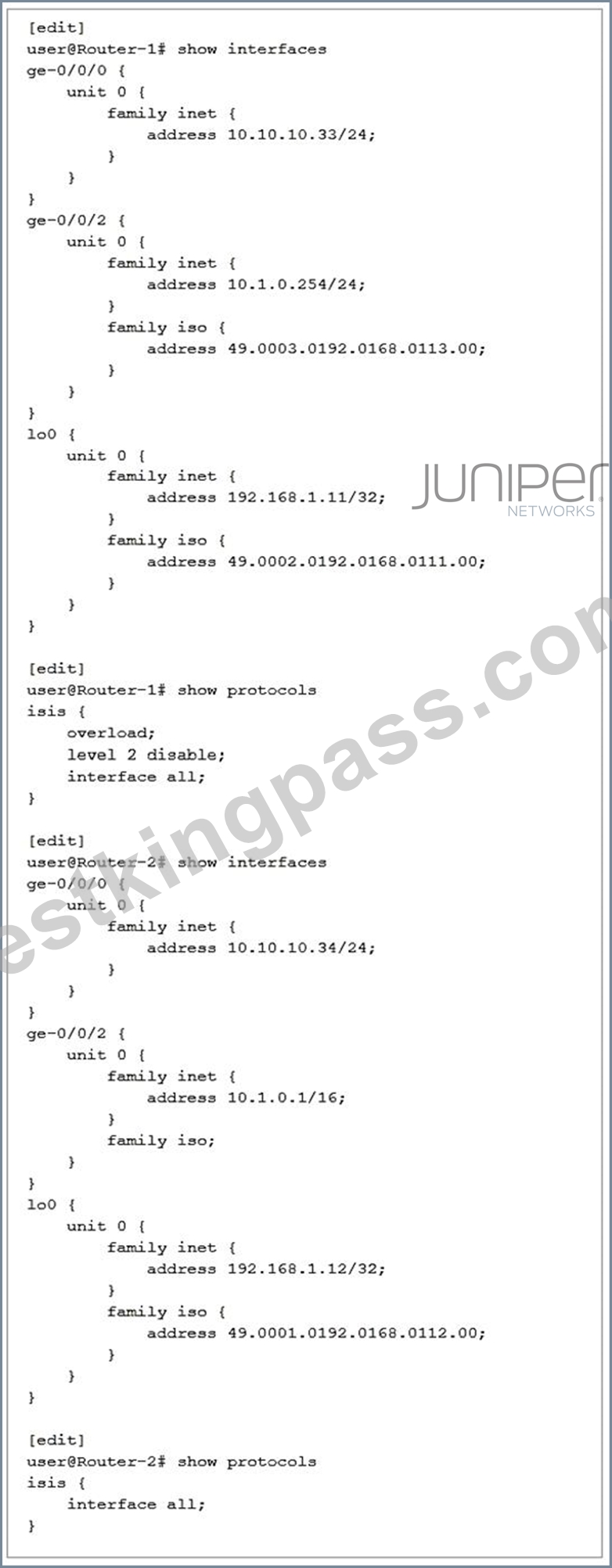
What should you do to solve the problem?
- A. Change the ISO areas on the lo0 interfaces to match on both routers.
- B. Remove the ISO address from ge-0/0/2 on Router-1.
- C. Remove the overloaded statement from Router-1.
- D. Change the IP subnet masks to match on the ge-0/0/2 interfaces of both routers.
Answer: B
NEW QUESTION # 40
What is the default MAC age-out timer on an EX Series switch?
- A. 300 seconds
- B. 30 minutes
- C. 30 seconds
- D. 300 minutes
Answer: A
Explanation:
The default MAC age-out timer on an EX Series switch is 300 seconds 1 2 . The MAC age-out timer is the maximum time that an entry can remain in the MAC table before it "ages out," or is removed 3 1 . This configuration can influence efficiency of network resource use by affecting the amount of traffic that is flooded to all interfaces 1 . When traffic is received for MAC addresses no longer in the Ethernet routing table, the router floods the traffic to all interfaces 1 .
NEW QUESTION # 41
Which statement about the default action of MAC limiting is true when the number of MAC addresses has hit the limit set?
- A. The switch will shut down the offending port for five minutes.
- B. The switch stops learning MAC addresses on the offending port, and any traffic to or from the offending MAC address will be dropped.
- C. The switch will shut down MAC learning on the offending port for five minutes.
- D. The switch stops learning MAC addresses on the offending port, but floods traffic out of all ports for the offending MAC address.
Answer: B
Explanation:
According to the Juniper documentation 1 , MAC limiting is a feature that enhances port security by limiting the number of MAC addresses that can be learned within a VLAN. When the MAC limit is exceeded, the switch can perform different actions, such as ignoring, dropping, logging, shutting down, or disabling the offending port. The default action is to drop the packets with new MAC addresses and log a message 2 .
Therefore, the correct answer is B.
The other options are not correct because:
* A. The switch will not shut down the offending port for five minutes by default. This is a configurable action, but not the default one 2 .
* C. The switch will not flood traffic out of all ports for the offending MAC address by default. This is a possible consequence of ignoring the packets with new MAC addresses, but not the default action 2 .
* D. The switch will not shut down MAC learning on the offending port for five minutes by default. This is another configurable action, but not the default one 2 .
References: Understanding MAC Limiting and MAC Move Limiting | Junos OS , Configuring MAC Limiting | Junos OS
NEW QUESTION # 42
Which statement is correct about controlling the routes installed by a RIB group?
- A. An import policy is applied to the RIB group.
- B. A firewall filter must be configured to install routes in the RIB groups.
- C. An export policy is applied to the RIB group.
- D. Only routes in the last table are installed.
Answer: A
Explanation:
A RIB group is a configuration that allows a routing protocol to install routes into multiple routing tables in Junos OS. A RIB group consists of an import-rib statement, which specifies the source routing table, and an export-rib statement, which specifies the destination routing table or group. A RIB group can also include an import-policy statement, which specifies one or more policies to control which routes are imported into the destination routing table or group 1 .
An import policy is a policy statement that defines the criteria for accepting or rejecting routes from the source routing table. An import policy can also modify the attributes of the imported routes, such as preference, metric, or community. An import policy can be applied to a RIB group by using the import-policy statement under the [edit routing-options rib-groups] hierarchy level 1 .
Therefore, option A is correct, because an import policy is applied to the RIB group to control which routes are installed in the destination routing table or group. Option B is incorrect, because all routes in the source routing table are imported into the destination routing table or group, unless filtered by an import policy.
Option C is incorrect, because a firewall filter is not used to install routes in the RIB groups; a firewall filter is used to filter packets based on various criteria. Option D is incorrect, because an export policy is not applied to the RIB group; an export policy is applied to a routing protocol to control which routes are advertised to other devices.
References:
1 : rib-groups | Junos OS | Juniper Networks
https://www.juniper.net/documentation/us/en/software/junos/static-routing/topics/ref/statement/rib-groups- edit-routing-options.html
NEW QUESTION # 43
......
Get Ready with JN0-351 Exam Dumps (2026): https://prepaway.testkingpass.com/JN0-351-testking-dumps.html