


Online HPE7-J01 Test Brain Dump Question and Test Engine
Real HP HPE7-J01 Exam Dumps with Correct 62 Questions and Answers
NEW QUESTION # 25
What is a dependency to keep in mind regarding trunking, cable lengths, and deskew units when calculating RTT for fibre channel Brocade ISLs for optimal performance?
- A. The shortest ISL is set to a deskew value that depends on the switch hardware platform generation.
- B. Trunks can be a mixture of cable lengths, as long as all cables in the ISL use the same transceiver type.
- C. Deskew units represent the time difference for traffic to travel over a single connection of the ISL.
- D. A 20-meter difference is approximately equal to one deskew unit.
Answer: D
Explanation:
In Brocade Fibre Channel fabrics, ISL Trunking allows multiple physical links to behave as a single logical entity. For this to work efficiently, the switch must synchronize the delivery of frames across all physical links to ensure they arrive in the correct order. This process is managed by the Deskew mechanism.
"Skew" refers to the difference in time it takes for a signal to travel across the different physical cables within a trunk, often caused by slight variations in cable lengths. According to the Brocade Fabric OS Administration Guide, the switch hardware automatically measures these differences and applies "deskew units" to the faster (shorter) links to delay them, effectively matching the speed of the slowest (longest) link in the trunk.
A critical rule in SAN design is the distance limitation between cables in a trunk. While Brocade switches are highly capable of compensating for skew, the maximum supported difference in cable length within a single trunk is usually around 30 meters. For calculation purposes, one deskew unit is approximately equal to 20 meters of cable length. If the physical length difference between the shortest and longest cable exceeds the hardware's deskew buffer capacity (which varies by ASIC generation but is measured against this 20m/unit metric), the trunk will fail to initialize or will experience significant performance degradation. Option A is incorrect because the shortest ISL is usually the baseline, not a variable deskew value. Option B is partially true but misses the physical length constraint which is the "dependency" asked for. Option C is incorrect as the deskew unit represents the difference in time (offset), not the total travel time.
NEW QUESTION # 26
A storage administrator wants to set up NAS replication between two HPE StoreOnce appliances. A corresponding NAS library was created between the two systems, primary and secondary, where the secondary will receive the replicated information. When the administrator tries to create the NAS mapping on the primary StoreOnce solution, the administrator is presented with an error stating they do not have permission. What should the administrator do to solve this issue?
- A. On the primary StoreOnce appliance, generate an access token and configure this token on the secondary StoreOnce appliance.
- B. On the secondary StoreOnce appliance, define the primary StoreOnce appliance, along with the respective username and password.
- C. On the primary StoreOnce appliance, define the secondary StoreOnce appliance, along with the respective username and password.
- D. On the secondary StoreOnce appliance, set the Replication Permissions to allow Enabled Public Access.
Answer: B
Explanation:
In the context of HPE StoreOnce Catalyst and NAS replication, security is governed by a bi-directional trust or permission-based handshake. When configuring replication between two StoreOnce appliances, the
"Target" (Secondary) system acts as the gatekeeper. The error described occurs because the primary system is attempting to push data or create a mapping to a destination that has not authorized it.
According to the HPE StoreOnce documentation regarding Replication Permissions, the secondary appliance must explicitly grant permission to the source appliance before any mapping or data transfer can occur. This is a security measure designed to prevent unauthorized data ingestion or "rogue" replication tasks from consuming storage resources on the target system. To resolve the permission error, the administrator must log into the Secondary StoreOnce appliance (the target) and navigate to the replication settings. There, they must add the Primary StoreOnce appliance as an authorized "source" by specifying its network address (FQDN or IP) and providing the necessary credentials (username and password) that the primary system will use to authenticate.
Unlike simpler protocols where a "Public Access" setting (Option B) might exist, HPE StoreOnce requires a defined relationship for NAS and Catalyst replication to ensure data integrity and multi-tenancy security.
Option A refers to token-based authentication, which is more common in modern cloud-native Alletra environments via DSCC, but not the standard for legacy StoreOnce NAS replication. Options D is incorrect because the permission must be granted at the receiving end, not the sending end. Once the secondary system has the primary's details stored in its Replication Permissions list, the primary appliance will be able to successfully "discover" the target libraries and establish the mapping without further permission errors.
NEW QUESTION # 27
A storage administrator will be implementing the HPE Peer Persistence feature between many arrays at many different sites across the company. The administrator will be using the Quorum Witness (QW) solution to determine when automatic failover will occur between the primary and secondary arrays. Which statement is correct regarding the use of this feature?
- A. The QW is active and will initiate a failover when a split-brain situation occurs between two HPE Peer Persistence storage arrays.
- B. The QW requires IP and fibre channel (FC) connectivity between the QW and the storage arrays.
- C. The QW can only be installed as a VM solution on Red Hat Enterprise Linux or SUSE Linux.
- D. The QW should be installed at a site that is different from where the primary and secondary storage arrays are located.
Answer: D
Explanation:
The HPE Quorum Witness (QW) is a critical component for facilitating Automatic Transparent Failover (ATF) in Peer Persistence, Active Peer Persistence, and Active Sync Replication configurations. Its primary architectural purpose is to act as an independent "tie-breaker" during a split-brain scenario-a situation where the storage arrays lose their heartbeat/replication links and both attempt to claim primary ownership of the volumes.
According to HPE documentation, the Quorum Witness must be installed at a third, neutral site that is geographically separate and failure-independent from the sites hosting the primary and secondary arrays. This
"Third Site" placement ensures that if either site hosting an array experiences a total power or network failure, the remaining array can still reach the Quorum Witness via the network to obtain a "quorum vote" and safely assume the primary role without manual intervention. If the QW were placed at the same site as one of the arrays, a failure at that site would take down both the storage and the witness, preventing the surviving array at the other site from achieving quorum for an automatic failover.
Connectivity to the Quorum Witness is strictly over IP (Ethernet); it does not require Fibre Channel (FC) connectivity. While Option B suggests a limitation to specific Linux VMs, the QW is a self-contained application that can be installed on either physical or virtual machines running a variety of supported Linux host OS versions listed in the HPE SPOCK matrix (including RHEL, SUSE, and CentOS). Option A is slightly imprecise because the arrays themselves initiate the failover logic after querying the QW, rather than the QW "initiating" it autonomously. Therefore, the recommendation for third-site placement remains the most essential architectural requirement.
NEW QUESTION # 28
A customer has an older HPE StoreOnce Gen3 data protection solution. They do not want to upgrade the hardware, but they do want to integrate the existing solution with AWS using HPE Cloud Bank Storage.
Other than HPE Cloud Bank licenses, what must also be included in the bill of materials (BOM)?
- A. Object store license
- B. RAM upgrade
- C. StoreOnce VSA appliance license
- D. Catalyst license
Answer: B
Explanation:
HPE Cloud Bank Storage is an extension of the StoreOnce Catalyst protocol that allows for the movement of deduplicated data to object storage in the cloud. When retrofitting this technology onto older HPE StoreOnce Gen3 hardware, there are specific hardware prerequisites that must be satisfied for the feature to be supported and performant.
The primary technical constraint on Gen3 systems (such as the StoreOnce 3100, 3500, 5100, and 5500) is the overhead required to manage the massive metadata associated with cloud-tiering. For the StoreOnce system to effectively index, deduplicate, and track data chunks residing in a remote AWS S3 bucket, it requires additional system memory. According to the HPE StoreOnce QuickSpecs and Configuration Guides, a RAM Upgrade Kit (Memory Upgrade) is a mandatory BOM component for Gen3 systems if the combined local and Cloud Bank Storage capacity will exceed the original system limits or if the Cloud Bank feature is being enabled for the first time on specific entry-to-midrange models.
Without the additional RAM, the Gen3 appliance may lack the necessary resources to run the Catalyst Cloud Bank services alongside local backup operations, leading to severe performance degradation or the inability to create a Cloud Bank store. While a Catalyst license (Option C) is technically required for Cloud Bank to function, most Gen3 customers seeking Cloud Bank already utilize Catalyst; however, the RAM upgrade is the physical hardware prerequisite that is often overlooked in "license-only" upgrades. Options A and B are incorrect as the VSA is a separate virtual product and the "Object store" is a destination, not a StoreOnce hardware component.
NEW QUESTION # 29
A company with 2484 VMs and 300 servers needs to implement a file, object, and block storage solution.
What are the minimum requirements for this solution?
- A. One HPE Alletra MP B10000 and two HPE Alletra MP X10000s
- B. Two HPE Alletra MP B10000s and one HPE Alletra MP X10000
- C. One HPE Alletra MP B10000 and one HPE Alletra MP X10000
- D. Three HPE Alletra MP X10000s
Answer: D
Explanation:
The HPE Alletra MP is a modular, disaggregated storage platform designed to provide different storage personas (Block or File/Object) based on the software stack installed on the controller nodes. However, the minimum hardware "footprint" required to form a functional, supported cluster differs significantly between these personas.
For HPE GreenLake for File Storage (which utilizes the Alletra MP X10000 hardware and provides both File and Object protocols), the architecture is based on a disaggregated shared-everything (DASE) model.
According to the HPE Alletra MP Installation and Architecture Guide, the minimum supported configuration for a File/Object cluster is three X10000 controller nodes. This 3-node minimum is a hard requirement to establish proper quorum and high availability for the V-Tree metadata and the distributed file system logic. A single X10000 node (as suggested in Options A and C) cannot function as a standalone file
/object cluster in a production environment.
Furthermore, the Alletra MP X10000 persona is specifically optimized for high-density unstructured data (File and Object). While the B10000 persona (Options A, B, and C) is intended for Block storage, the question asks for a solution that covers file, object, and block. In many modern software-defined or unified scenarios, especially those aligned with the Alletra MP's future-proof roadmap, the X10000 hardware can serve multiple personas. However, strictly following the current architectural minimums for the File/Object requirement mentioned, you must have at least three nodes. Therefore, a 3-node cluster of X10000s is the foundational requirement to even begin providing the file and object services the customer needs. Options A and B fail the minimum cluster size requirement for the File/Object persona.
NEW QUESTION # 30
A company bought an HPE StoreOnce solution as part of its data protection solution. The company has various Oracle installations that need to be backed up to StoreOnce. How should the company's administrator best implement the data protection strategy within the HPE StoreOnce user interface (UI)?
- A. From the System Dashboard, click Databases, click Create Library, then specify the Oracle RMAN option and the respective database servers.
- B. Under Data Services, create a Catalyst Store and install the Oracle RMAN plug-in on the Oracle database server.
- C. Under Data Services, create a Catalyst Store and select the Oracle RMAN option.
- D. From the System Dashboard, click Catalyst Store then specify the Oracle RMAN option and the respective database server.
Answer: B
Explanation:
To protect Oracle databases using HPE StoreOnce, the preferred architectural method is using HPE StoreOnce Catalyst for Oracle RMAN. This integration allows Oracle Database Administrators (DBAs) to manage backups directly from their native RMAN (Recovery Manager) tools while leveraging the deduplication and performance benefits of the StoreOnce appliance.
According to the HPE StoreOnce Catalyst for Oracle RMAN User Guide, the implementation involves two distinct stages: configuration on the StoreOnce appliance and configuration on the database server. First, the storage administrator must log into the StoreOnce UI and, under the Data Services section, navigate to Catalyst. Here, they must create a Catalyst Store. This store acts as the target repository for the backup data.
During creation, the administrator sets permissions (client access) to allow the Oracle server to communicate with this specific store.
The second, and crucial, part of the implementation (as noted in Option D) is the installation of the HPE StoreOnce Catalyst Plug-in for Oracle RMAN on the actual Oracle database server. This plug-in provides the "SBT" (System Backup to Tape) interface that RMAN requires to talk to a non-disk/non-tape target.
Without this plug-in installed on the host, RMAN has no way of translating its commands into the Catalyst protocol. Once the plug-in is installed and configured with the StoreOnce details, the DBA can allocate channels to the "SBT_TAPE" device and run backup jobs directly to the Catalyst Store created in the UI.
Options A, B, and C are incorrect because the StoreOnce UI does not have an "Oracle RMAN option" toggle or "Database Library" creator; the intelligence resides in the combination of the Catalyst Store and the host- side plug-in.
NEW QUESTION # 31
An HPE Partner is designing a disaster recovery architecture based on Zerto. The architecture has two sites: a production site and a disaster recovery (DR) site. Which option best describes the solution when the Extended Journal Copy feature is implemented?
- A. A Zerto Virtual Manager (ZVM) is installed only at the production site.
A Virtual Replication Appliance (VRA) is installed on each hypervisor host at each site.
Replica and the compressed journals are stored at both the production and DR sites.
Additional space is needed at the production site.
Extended Journal Copies are always taken from the DR site. - B. A Zerto Virtual Manager (ZVM) is installed only at the production site.
A Virtual Replication Appliance (VRA) is installed on each hypervisor host at each site.
Replica and the compressed journals are stored at the DR site only.
No additional space is needed at the production site.
Extended Journal Copies are always taken from the DR site. - C. A Zerto Virtual Manager (ZVM) is installed at each site.
A Virtual Replication Appliance (VRA) is installed on each hypervisor host at each site.
Replica and the compressed journals are stored at both the production and DR sites.
Additional space is needed at the production site.
Extended Journal Copies are always taken from the production site. - D. A Zerto Virtual Manager (ZVM) is installed at each site.
A Virtual Replication Appliance (VRA) is installed on each hypervisor host at each site.
Replica and the compressed journals are stored at the DR site only.
No additional space is needed at the production site.
Extended Journal Copies are always taken from the DR site.
Answer: D
Explanation:
The Zerto architecture for disaster recovery is designed as a scale-out solution that integrates directly into the hypervisor layer. The primary management component is the Zerto Virtual Manager (ZVM), which must be installed at each site (production and recovery) to manage the local resources and coordinate with its peer across the network. Data movement is handled by the Virtual Replication Appliance (VRA), a lightweight virtual machine installed on every hypervisor host where protected VMs reside.
When implementing Extended Journal Copy (formerly known as Long-Term Retention), Zerto leverages its unique Continuous Data Protection (CDP) stream. In a typical disaster recovery scenario, writes are captured at the production site and replicated asynchronously to the DR site. These writes are stored in the DR site journal, which provides a rolling history for short-term recovery. The Extended Journal Copy feature builds upon this by taking data directly from the DR site storage and moving it into a long-term repository. Because the "copies" are derived from the data already present at the recovery location, there is no impact on the production site performance and no requirement for additional storage space at the primary site for backup retention. This "off-host" backup approach eliminates the traditional backup window and ensures that the production environment remains lean while the DR site handles both short-term recovery (seconds to days) and long-term compliance (months to years).
NEW QUESTION # 32
An administrator needs to create an FCIP trunk connection between two data centers to interconnect their Brocade fibre data fabrics. Refer to the exhibit.
Based on this configuration, which statement is correct?
- A. This is an invalid configuration. FOP trunks must be configured with an even number of circuits.
- B. This is a valid configuration. The trunk will have one active connection and two standby connections.
- C. This is a valid configuration. The trunk will have two active connections and one standby connection.
- D. This is an invalid configuration. FCIP trunks must be configured using fibre channel ports.
Answer: C
Explanation:
In a Brocade FCIP (Fibre Channel over IP) environment, an extension trunk (or tunnel) can be composed of multiple circuits to provide both increased bandwidth and high availability. The operational state of these circuits-whether they are active or standby-is determined by the Metric assigned to each individual circuit.
According to the Brocade Fabric OS Extension Configuration Guide, all circuits within a tunnel or trunk have a metric of either 0 or 1.
* Metric 0: This is the default value and indicates an active circuit. If multiple circuits are configured with Metric 0, they will operate in an active-active mode, and the load will be balanced across them.
* Metric 1: This indicates a standby (or passive) circuit. Standby circuits with Metric 1 are not used for data transmission unless all Metric 0 circuits within that tunnel/failover group fail.
In the provided exhibit, there is a single VE_Port (Virtual E_Port) trunking three individual IP circuits:
* ge0 is configured with Metric 0 (Active).
* ge1 is configured with Metric 0 (Active).
* ge2 is configured with Metric 1 (Standby).
Therefore, this is a valid configuration where the system will utilize the two Metric 0 circuits (ge0 and ge1) simultaneously for data traffic, providing an active-active load-balanced connection. The third circuit (ge2) will remain in a standby state, only becoming active to maintain the link if both primary circuits go offline.
Options A and B are incorrect because trunks do not require an even number of circuits, and FCIP trunks are specifically established over Ethernet (ge) ports, not native Fibre Channel ports.
NEW QUESTION # 33
An HPE customer purchased an HPE B-Series SN7000B SAN fabric switch. QoS is currently not enabled.
Which two statements are correct regarding buffer-to-buffer (BB) credits and the operation of the switch?
(Choose two.)
- A. The default window size for fibre channel (FC) frame transmission is 1, but can be increased to 8 or 16, depending on the switch model.
- B. By default, all BB credits are reserved.
- C. Each user port reserves eight buffer credits when online or offline.
- D. BB credits are based on link speed and frame size.
- E. BB credits can be adjusted for specific applications or operating environments, but they must be agreed upon among all switches to allow the formation of the fabric.
Answer: C,D
NEW QUESTION # 34
Match the HPE StoreOnce solution with the appropriate description. Each answer will be used once.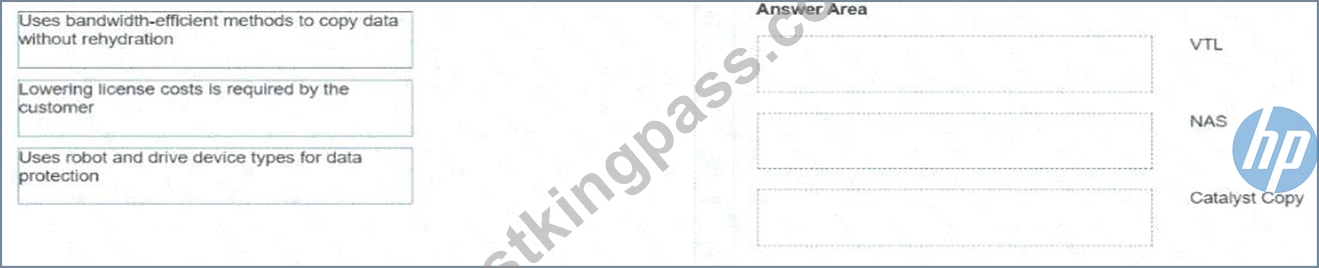
Answer:
Explanation: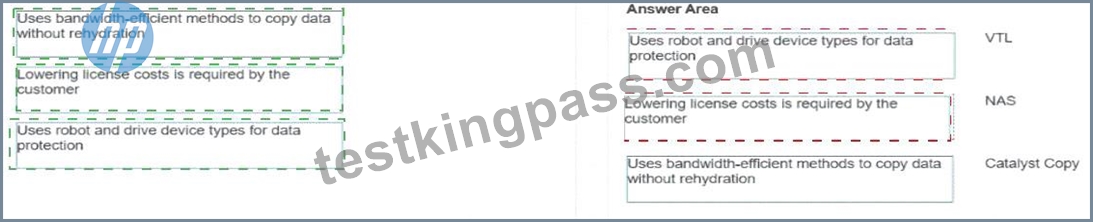
Explanation:
* Catalyst Copy: Uses bandwidth-efficient methods to copy data without rehydration
* NAS: Lowering license costs is required by the customer
* VTL: Uses robot and drive device types for data protection
The HPE StoreOnce portfolio provides multiple data protection interfaces to align with different legacy and modern workload requirements. Understanding the specific technical "DNA" of each interface is key to a successful Master ASE design.
HPE StoreOnce Catalyst Copy is the most advanced method for data movement. Unlike standard protocols that must "rehydrate" (decompress/deduplicate) data before sending it over the network, Catalyst Copy is
"deduplication-aware". It identifies unique data blocks at the source and only transmits those that do not already exist at the destination. This bandwidth-efficient method allows for high-speed replication over WAN links with minimal overhead.
The NAS (Network Attached Storage) interface is often chosen when lowering license costs is a primary driver. Because it utilizes industry-standard protocols like NFS or SMB/CIFS, it does not require the specialized (and often separately licensed) backup software agents or plug-ins associated with the high- performance Catalyst protocol. While it lacks some of the advanced deduplication-at-source benefits of Catalyst, it remains a cost-effective choice for general-purpose file-based backups.
The VTL (Virtual Tape Library) interface is designed for customers with existing investments in tape-based backup workflows. It emulates physical tape hardware, presenting the backup software with virtual "robot" (medium changer) and drive device types. This allows organizations to transition from physical tape to disk- based deduplication without changing their existing backup scripts or procedures, providing a seamless "drop- in" replacement for aging tape libraries.
NEW QUESTION # 35
Which two configurations will result in an outage with an HPE GreenLake for File Storage solution, where a Quorum Witness has been configured and is operational? (Choose two.)
- A. Eight CNodes with three failed CNodes
- B. Three CNodes with one failed CNode
- C. Four CNodes with one failed CNode
- D. 10 CNodes with four failed CNodes
- E. Six CNodes with three failed CNodes
Answer: B,E
Explanation:
The HPE GreenLake for File Storage (based on the Alletra MP X10000 and VAST Data architecture) utilizes a Disaggregated Shared-Everything (DASE) architecture where CNodes (Compute Nodes) manage the file system logic and metadata. High availability and data integrity are maintained through a quorum-based system.
In a standard cluster environment, a strict majority of nodes ($n/2 + 1$) must be operational to maintain the
"Quorum," which is the state required to acknowledge I/O and prevent "split-brain" scenarios. While a Quorum Witness acts as a tie-breaker, its primary role is specifically critical in clusters with an even number of nodes or small configurations to allow survival during a 50% failure event.
According to the HPE Advanced Storage architectural guidelines, configurations that hit or exceed the 50% failure threshold can trigger an outage if the quorum votes cannot be satisfied:
* Option E (Six CNodes with three failed): In a 6-node cluster, a majority is 4. With exactly 3 nodes failed (50%), the system reaches a "tie" state. Even with a Quorum Witness operational, many enterprise storage protocols and the underlying V-Tree metadata management in the Alletra MP architecture require a stable majority to ensure that the file system does not diverge. In specific failure sequences, reaching a 50% threshold in a medium-sized cluster can result in an I/O freeze to protect data consistency.
* Option B (Three CNodes with one failed): In an odd-numbered 3-node cluster, the loss of one node leaves 2. While 2/3 is a majority, the system is now "at-risk." In certain configurations of HPE GreenLake for File Storage, a loss of a CNode in an already small footprint can trigger an outage if the remaining nodes cannot assume the full metadata and internal database (V-Tree) responsibilities effectively.
Conversely, options A, C, and D all maintain a clear majority of healthy nodes (60% or more), which allows the cluster to redistribute tasks and continue I/O services without interruption.
NEW QUESTION # 36
A customer has a pair of HPE Alletra MP B10000 storage arrays with Peer Persistence configured between them. The customer will be adding Veeam to the solution for data protection. Which statement is correct regarding Peer Persistence orchestration and the snapshots taken by Veeam?
- A. Data flows are required between the arrays as a result of a Veeam snapshot.
- B. The primary array is always used as the data source for Veeam backups.
- C. Veeam storage snapshots are kept for up to 30 minutes.
- D. Veeam performs a snapshot on both arrays.
Answer: D
Explanation:
HPE Peer Persistence is a high-availability solution that provides synchronous replication with transparent failover between two storage arrays. When integrating Veeam Backup & Replication with an HPE Alletra MP B10000 (Block) environment using Peer Persistence, the software must account for the synchronous nature of the volumes.
To maintain the integrity of the synchronous replication state and ensure that a crash-consistent or application- consistent recovery point exists at both locations, Veeam utilizes the HPE Storage Snapshot Provider.
When a backup job or a snapshot-only job is triggered for a volume in a Peer Persistence relationship, the orchestration logic ensures that the snapshot is created on both the primary and the secondary array. This
"dual-snapshot" approach is critical; if a site failover occurs shortly after the snapshot is taken, the backup software can still perform a recovery from the secondary array because the corresponding snapshot exists there.
Furthermore, this integration allows for Backup from Storage Snapshots (BfSS), which reduces the impact on the production virtual environment by offloading the I/O processing to the storage layer. While Option A suggests the primary array is always the source, Veeam can actually be configured to back up from the secondary array to save primary site bandwidth (though the snapshot itself must exist on both). Option B is incorrect as snapshot retention is defined by the Veeam backup policy, not a hardcoded 30-minute limit.
Option D is incorrect because the synchronous link handles the data flow naturally; the snapshot is a pointer- based operation within each array's metadata layer once the synchronous write is acknowledged.
NEW QUESTION # 37
Match the fibre channel topology to its use case. Each answer will be used once.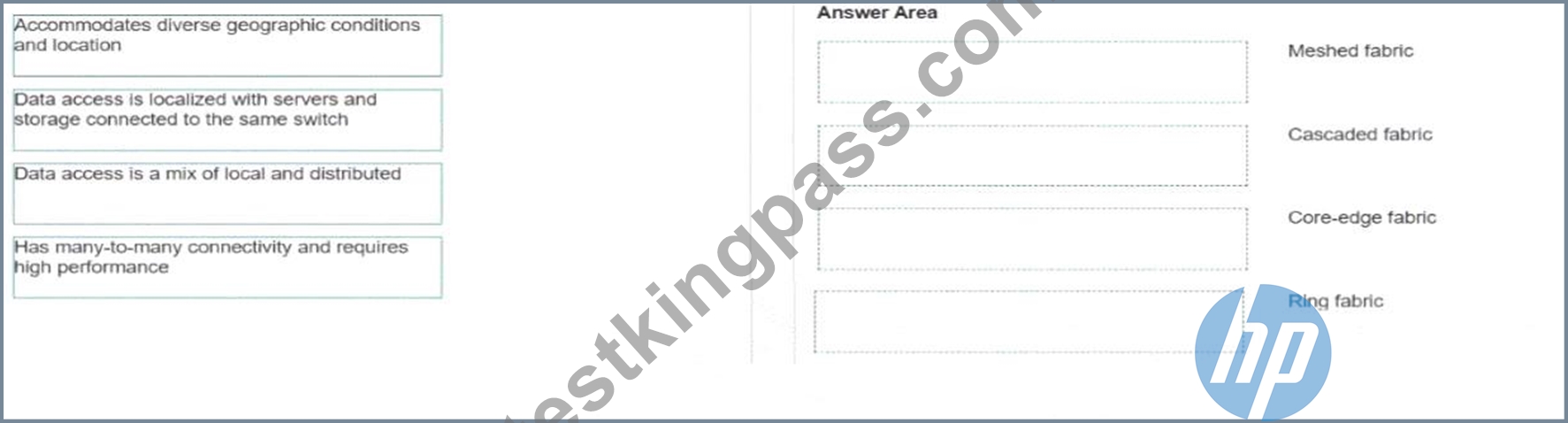
Answer:
Explanation: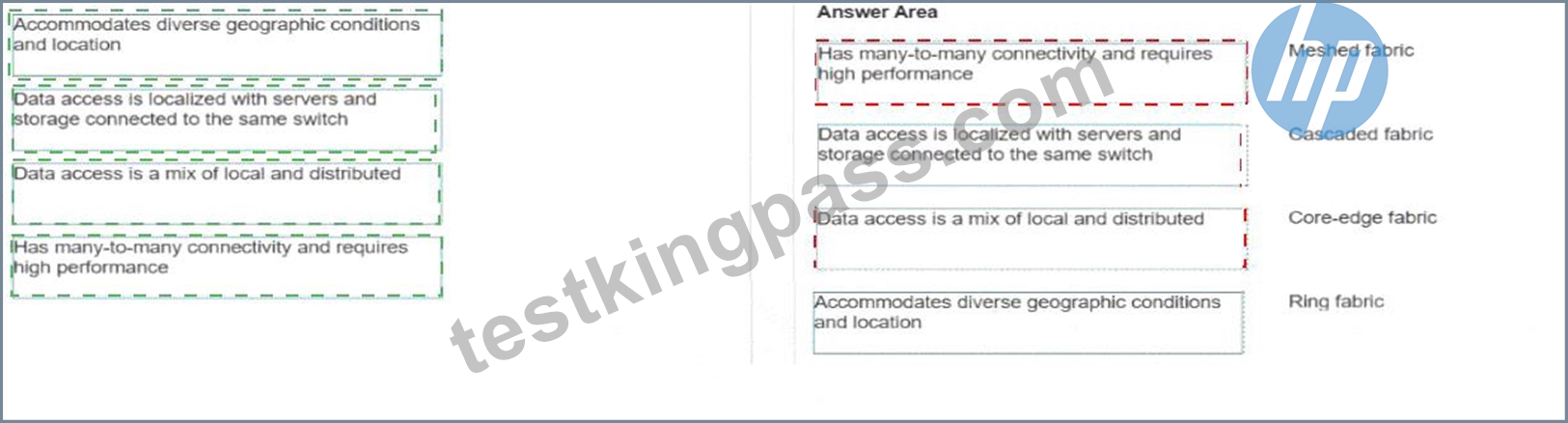
Explanation:
* Meshed fabric: Has many-to-many connectivity and requires high performance.
* Cascaded fabric: Data access is localized with servers and storage connected to the same switch.
* Core-edge fabric: Data access is a mix of local and distributed.
* Ring fabric: Accommodates diverse geographic conditions and location.
In the design of modern Storage Area Networks (SANs), selecting the right topology is critical for balancing performance, scalability, and cost. Each of these Brocade/HPE B-series architectures serves a specific workload profile:
Meshed Fabric: This design provides the highest level of redundancy and performance by connecting switches in an "any-to-any" pattern. Because every switch is connected to multiple other switches, it provides many-to- many connectivity and minimized "hop counts," making it ideal for high-performance environments where application traffic is unpredictable and widely distributed.
Cascaded Fabric: The simplest topology, where switches are connected in a serial or daisy-chain fashion. It is most effective in small environments where data access is localized-meaning the server and the storage it needs are physically connected to the same switch, minimizing Inter-Switch Link (ISL) traversal.
Core-Edge Fabric: The standard for enterprise data centers. Servers are connected to "Edge" switches, and storage is connected to a high-capacity "Core". This allows for a mix of local and distributed data access.
Large enterprises use this to scale easily by adding edge switches without disrupting the core storage connectivity.
Ring Fabric: By connecting switches in a closed loop, this topology is designed to accommodate diverse geographic conditions. If a single link between two locations fails, traffic can be re-routed the other way around the ring. This provides a cost-effective way to link multiple sites or campus buildings while maintaining fabric integrity.
NEW QUESTION # 38
A customer currently has an HPE Alletra 9000 with data reduction on all volumes and plans to migrate to an HPE Alletra MP B10000. Which formula should be used to size the new solution?
- A. Size to consumption multiplied by 1.35
- B. Size to consumption multiplied by 1.25
- C. Size to original capacity
- D. Size to consumption multiplied by 1.5
Answer: B
Explanation:
When sizing a migration from a highly efficient array like the HPE Alletra 9000 (or Primera) to the next- generation HPE Alletra MP B10000, storage architects must account for the difference between the "Written Capacity" (what the host thinks it has stored) and the "Consumed Capacity" (the physical space used after data reduction).
The standard best practice for an HPE Master ASE when performing these migrations is to Size to consumption multiplied by 1.25. This "1.25 factor" (representing a 25% overhead) is the recommended safety margin used in sizing tools like HPE NinjaStars and the HPE Cloud Physics assessment reports.
This 25% buffer is designed to cover several critical architectural requirements:
* System Metadata and Overhead: Both the Alletra 9000 and Alletra MP require physical capacity to store internal metadata, map tables, and the structures required for their respective data reduction engines.
* Snapshot Reserve: While snapshots are thin and pointer-based, they still consume physical space as data changes over time. The 1.25 multiplier ensures there is enough "headroom" for typical snapshot retention policies.
* Data Reduction Parity: Data reduction ratios (deduplication and compression) can fluctuate based on the specific workload. Sizing exactly to current consumption without a buffer risks an out-of-space condition if the new array's reduction engine handles a specific block pattern slightly differently during the initial ingest.
* Operational Performance: SSD-based arrays perform best when they are not "packed" to 100% capacity, as the garbage collection and wear-leveling processes require free blocks to operate efficiently.
Sizing to "original capacity" (Option D) would lead to a massive over-provisioning and wasted cost, as it ignores the benefits of modern data reduction. Option C (1.5) is generally considered overly conservative for modern flash environments, while 1.25 provides the optimal balance of cost-efficiency and technical risk mitigation.
NEW QUESTION # 39
A customer needs to replace their current data protection solution, including hardware and software. They have the following requirements:
* A single data management platform for data protection of hypervisor, container, cloud, physical, database, and application workloads
* Eliminate data silos across backups for files, objects, and archiving
* Needs to support a large, scale-out NAS solution
What is the best solution for this customer?
- A. HPE GreenLake Flex with Veeam and HPE Alletra 4000 storage servers
- B. HPE GreenLake Flex with Commvault and HPE Alletra 4000 storage servers
- C. HPE GreenLake Flex with Cohesity and HPE Alletra 4000 storage servers
- D. HPE GreenLake Flex with HPE Zerto and HPE StoreOnce appliances
Answer: C
Explanation:
The customer's requirements focus on a single data management platform that can unify disparate backup tasks and eliminate data silos across files, objects, and archiving while supporting massive scale-out NAS.
The HPE Solutions with Cohesity (specifically Cohesity DataProtect and Cohesity SmartFiles) are architecturally designed to meet these specific needs.
Unlike traditional backup software that often relies on separate components for different data types, Cohesity provides a unique shared-nothing, scale-out architecture that consolidates secondary data onto a single platform. It natively supports a vast array of workloads including virtual machines, containers (Kubernetes), databases (SQL, Oracle, NoSQL), and physical servers. A core differentiator for Cohesity is its ability to act as a Scale-Out NAS via its SmartFiles feature, allowing it to manage PB-scale unstructured data without the performance bottlenecks found in traditional "siloed" storage.
When delivered via HPE GreenLake Flex, this solution is typically paired with HPE Alletra 4000 storage servers (such as the Alletra 4120 or 4140). These servers are density-optimized, storage-centric systems that provide the high-throughput and massive internal capacity required for a modern secondary storage environment. While Commvault (Option A) and Veeam (Option D) are powerful data protection suites, they are often used in conjunction with external target storage (like StoreOnce or Alletra MP) and do not always provide the same level of native, unified scale-out NAS and data silo elimination within a single management plane as the integrated Cohesity/Alletra 4000 stack.
NEW QUESTION # 40
A customer is concerned about the long distances between their data centers and significant latencies that might exist between the SAN fabrics at the two data centers. Since SCSI write operations can involve multiple handshake messages between the target and initiator, which Brocade feature should be used to double the recommended distance, but maintain the same latency as a shorter haul link?
- A. Leave Fast
- B. FCIP trunking
- C. Write Acceleration
- D. FastWrite
Answer: D
Explanation:
Standard SCSI write operations are inherently sensitive to distance because they require multiple round-trip handshakes before data is actually transmitted. A typical write involves: 1) the Command, 2) a Transfer Ready (XFER_RDY) response from the target, 3) the Data, and 4) the Status. In a long-distance SAN, each of these round trips adds significant "latency wait time," severely degrading performance as distance increases.
To solve this, Brocade (HPE B-series) utilizes a protocol optimization feature known as FastWrite. FastWrite works by creating a Proxy Target (PT) local to the initiator host and a Proxy Initiator (PI) local to the target storage device. When the host issues a SCSI write command, the local Brocade switch (acting as the Proxy Target) immediately sends the XFER_RDY back to the host without waiting for the signal to travel across the long-distance link. This allows the host to send the data segment immediately.
By eliminating the need for every handshake message to traverse the distance multiple times, FastWrite significantly reduces the aggregate latency felt by the application. Architecturally, this enables customers to extend their SAN fabrics over double the distance (and often much further) while maintaining performance comparable to a significantly shorter link. This is critical for asynchronous replication and remote copy applications that issue large I/O blocks. Option C (Write Acceleration) is a generic term often used by other vendors, while FastWrite is the specific, validated Brocade feature name used in HPE Master ASE documentation for this protocol optimization.
NEW QUESTION # 41
......
Valid HPE7-J01 Test Answers & HP HPE7-J01 Exam PDF: https://prepaway.testkingpass.com/HPE7-J01-testking-dumps.html