


[Feb 25, 2023] Free Microsoft Azure DP-100 Official Cert Guide PDF Download
Microsoft DP-100 Official Cert Guide PDF
Microsoft DP-100: Skills Measured
Microsoft provides you with the elaborate outline of the skills that you need to acquire before attempting the test. The specific topics of the exam along with the main subtopics are enumerated below:
- Perform Feature Engineering (15%)
Answering the questions that are drawn from this domain, the test takers should be able to perform the tasks such as performing feature selection as well as performing feature extraction.
- Prepare Data for Modeling (25%)
This subject area revolves around cleansing and transforming data; performing EDA (Exploratory Data Analysis); transforming data into usable datasets.
- Develop Models (40%)
The skills measured within this topic include selecting an algorithmic approach; evaluating model performance; training the model; identifying data imbalances; splitting datasets, and so on.
- Define and Prepare the Development Environment (15%)
To answer the questions within this objective, the applicants should have the professional ability to accomplish such technical tasks as selecting a development environment; quantifying the business problem; setting up a development environment; etc.
Conclusion
Data science is a lucrative career option and you can explore it without any hassle if you’ve managed to taste success in the Microsoft DP-100 exam, which is known to create a skilled workforce of Azure data scientists. However, a great outcome in such a test will only come if the aspirant is referring to the updated and recent study resources like the official courses provided by the exam vendor itself.
NEW QUESTION 117
You deploy a real-time inference service for a trained model.
The deployed model supports a business-critical application, and it is important to be able to monitor the data submitted to the web service and the predictions the data generates.
You need to implement a monitoring solution for the deployed model using minimal administrative effort.
What should you do?
- A. Enable Azure Application Insights for the service endpoint and view logged data in the Azure portal.
- B. View the explanations for the registered model in Azure ML studio.
- C. Create an ML Flow tracking URI that references the endpoint, and view the data logged by ML Flow.
- D. View the log files generated by the experiment used to train the model.
Answer: A
Explanation:
Configure logging with Azure Machine Learning studio
You can also enable Azure Application Insights from Azure Machine Learning studio. When you're ready to deploy your model as a web service, use the following steps to enable Application Insights:
1. Sign in to the studio at https://ml.azure.com.
2. Go to Models and select the model you want to deploy.
3. Select +Deploy.
4. Populate the Deploy model form.
5. Expand the Advanced menu.
6. Select Enable Application Insights diagnostics and data collection.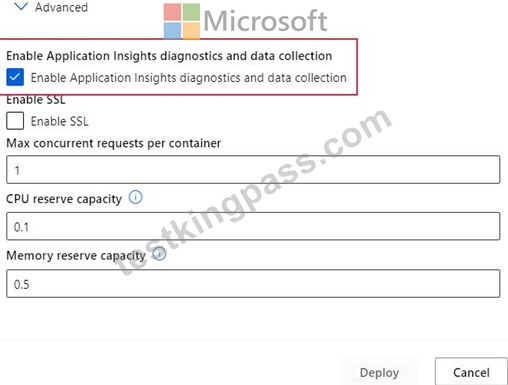
Reference:
https://docs.microsoft.com/en-us/azure/machine-learning/how-to-enable-app-insights
NEW QUESTION 118
You are hired as a data scientist at a winery. The previous data scientist used Azure Machine Learning.
You need to review the models and explain how each model makes decisions.
Which explainer modules should you use? To answer, select the appropriate options in the answer area.
NOTE: Each correct selection is worth one point.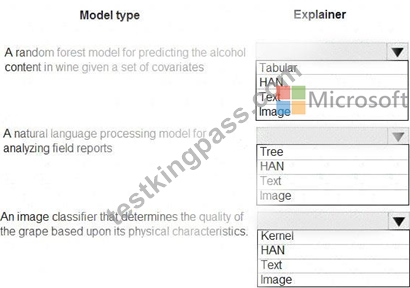
Answer:
Explanation:
Explanation
Meta explainers automatically select a suitable direct explainer and generate the best explanation info based on the given model and data sets. The meta explainers leverage all the libraries (SHAP, LIME, Mimic, etc.) that we have integrated or developed. The following are the meta explainers available in the SDK:
Tabular Explainer: Used with tabular datasets.
Text Explainer: Used with text datasets.
Image Explainer: Used with image datasets.
Box 1: Tabular
Box 2: Text
Box 3: Image
Reference:
https://medium.com/microsoftazure/automated-and-interpretable-machine-learning-d07975741298
NEW QUESTION 119
You are producing a multiple linear regression model in Azure Machine Learning Studio.
Several independent variables are highly correlated.
You need to select appropriate methods for conducting effective feature engineering on all the data.
Which three actions should you perform in sequence? To answer, move the appropriate actions from the list of actions to the answer area and arrange them in the correct order.
Answer:
Explanation:
Explanation
Step 1: Use the Filter Based Feature Selection module
Filter Based Feature Selection identifies the features in a dataset with the greatest predictive power.
The module outputs a dataset that contains the best feature columns, as ranked by predictive power. It also outputs the names of the features and their scores from the selected metric.
Step 2: Build a counting transform
A counting transform creates a transformation that turns count tables into features, so that you can apply the transformation to multiple datasets.
Step 3: Test the hypothesis using t-Test
References:
https://docs.microsoft.com/bs-latn-ba/azure/machine-learning/studio-module-reference/filter-based-feature-selec
https://docs.microsoft.com/en-us/azure/machine-learning/studio-module-reference/build-counting-transform
NEW QUESTION 120
The finance team asks you to train a model using data in an Azure Storage blob container named finance-data.
You need to register the container as a datastore in an Azure Machine Learning workspace and ensure that an error will be raised if the container does not exist.
How should you complete the code? To answer, select the appropriate options in the answer area.
NOTE: Each correct selection is worth one point.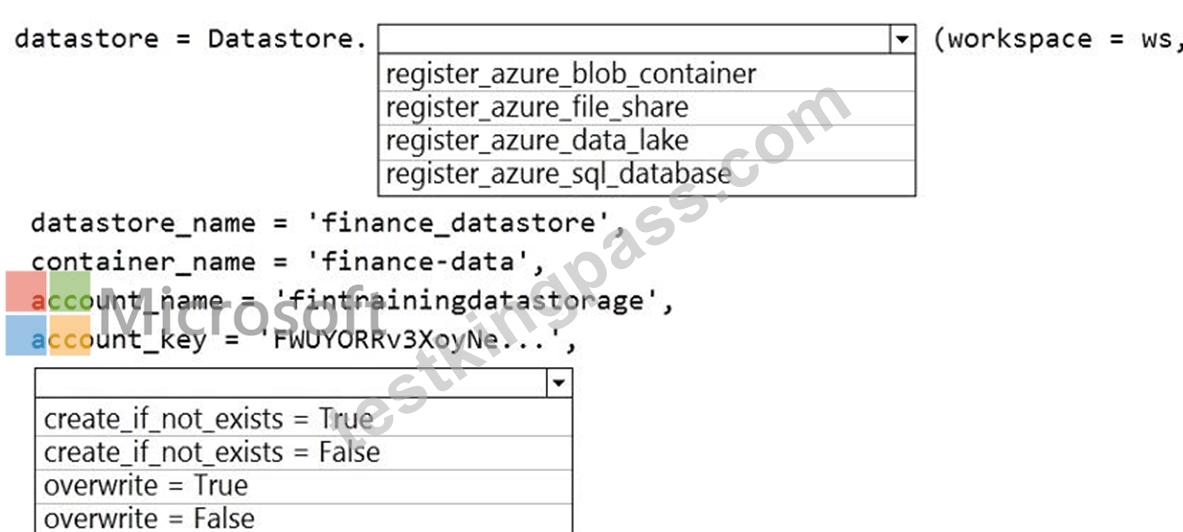
Answer:
Explanation:
Explanation:
Box 1: register_azure_blob_container
Register an Azure Blob Container to the datastore.
Box 2: create_if_not_exists = False
Create the file share if it does not exists, defaults to False.
Reference:
https://docs.microsoft.com/en-us/python/api/azureml-core/azureml.core.datastore.datastore
NEW QUESTION 121
You create machine learning models by using Azure Machine Learning.
You plan to train and score models by using a variety of compute contexts. You also plan to create a new compute resource in Azure Machine Learning studio.
You need to select the appropriate compute types.
Which compute types should you select? To answer, drag the appropriate compute types to the correct requirements. Each compute type may be used once, more than once, or not at all. You may need to drag the split bar between panes or scroll to view content.
NOTE: Each correct selection is worth one point.
Answer:
Explanation:
Explanation:
Box 1: Attached compute
Box 2: Inference cluster
Box 3: Training cluster
Box 4: Attached compute
NEW QUESTION 122
You plan to use a Deep Learning Virtual Machine (DLVM) to train deep learning models using Compute Unified Device Architecture (CUDA) computations.
You need to configure the DLVM to support CUDA.
What should you implement?
- A. High Random Access Memory (RAM) configuration
- B. Computer Processing Unit (CPU) speed increase by using overclocking
- C. Solid State Drives (SSD)
- D. Graphic Processing Unit (GPU)
- E. Intel Software Guard Extensions (Intel SGX) technology
Answer: D
Explanation:
A Deep Learning Virtual Machine is a pre-configured environment for deep learning using GPU instances.
References:
https://azuremarketplace.microsoft.com/en-au/marketplace/apps/microsoft-ads.dsvm-deep-learning
NEW QUESTION 123
Note: This question is part of a series of questions that present the same scenario. Each question in the series contains a unique solution that might meet the stated goals. Some question sets might have more than one correct solution, while others might not have a correct solution.
After you answer a question in this section, you will NOT be able to return to it. As a result, these questions will not appear in the review screen.
You create a model to forecast weather conditions based on historical data.
You need to create a pipeline that runs a processing script to load data from a datastore and pass the processed data to a machine learning model training script.
Solution: Run the following code:
Does the solution meet the goal?
- A. No
- B. Yes
Answer: B
Explanation:
Explanation
The two steps are present: process_step and train_step
Note:
Data used in pipeline can be produced by one step and consumed in another step by providing a PipelineData object as an output of one step and an input of one or more subsequent steps.
PipelineData objects are also used when constructing Pipelines to describe step dependencies. To specify that a step requires the output of another step as input, use a PipelineData object in the constructor of both steps.
For example, the pipeline train step depends on the process_step_output output of the pipeline process step:
from azureml.pipeline.core import Pipeline, PipelineData
from azureml.pipeline.steps import PythonScriptStep
datastore = ws.get_default_datastore()
process_step_output = PipelineData("processed_data", datastore=datastore) process_step = PythonScriptStep(script_name="process.py", arguments=["--data_for_train", process_step_output], outputs=[process_step_output], compute_target=aml_compute, source_directory=process_directory) train_step = PythonScriptStep(script_name="train.py", arguments=["--data_for_train", process_step_output], inputs=[process_step_output], compute_target=aml_compute, source_directory=train_directory) pipeline = Pipeline(workspace=ws, steps=[process_step, train_step]) Reference:
https://docs.microsoft.com/en-us/python/api/azureml-pipeline-core/azureml.pipeline.core.pipelinedata?view=azu
NEW QUESTION 124
You publish a batch inferencing pipeline that will be used by a business application.
The application developers need to know which information should be submitted to and returned by the REST interface for the published pipeline.
You need to identify the information required in the REST request and returned as a response from the published pipeline.
Which values should you use in the REST request and to expect in the response? To answer, select the appropriate options in the answer area.
NOTE: Each correct selection is worth one point.
Answer:
Explanation:
Reference:
https://docs.microsoft.com/en-us/azure/machine-learning/tutorial-pipeline-batch-scoring-classification
NEW QUESTION 125
Note: This question is part of a series of questions that present the same scenario. Each question in the series contains a unique solution that might meet the stated goals. Some question sets might have more than one correct solution, while others might not have a correct solution.
After you answer a question in this section, you will NOT be able to return to it. As a result, these questions will not appear in the review screen.
An IT department creates the following Azure resource groups and resources:
The IT department creates an Azure Kubernetes Service (AKS)-based inference compute target named aks-cluster in the Azure Machine Learning workspace.
You have a Microsoft Surface Book computer with a GPU. Python 3.6 and Visual Studio Code are installed.
You need to run a script that trains a deep neural network (DNN) model and logs the loss and accuracy metrics.
Solution: Attach the mlvm virtual machine as a compute target in the Azure Machine Learning workspace. Install the Azure ML SDK on the Surface Book and run Python code to connect to the workspace. Run the training script as an experiment on the mlvm remote compute resource.
- A. No
- B. Yes
Answer: B
Explanation:
Use the VM as a compute target.
Note: A compute target is a designated compute resource/environment where you run your training script or host your service deployment. This location may be your local machine or a cloud-based compute resource.
Reference:
https://docs.microsoft.com/en-us/azure/machine-learning/concept-compute-target
NEW QUESTION 126
You need to identify the methods for dividing the data according, to the testing requirements.
Which properties should you select? To answer, select the appropriate option-, m the answer area. NOTE: Each correct selection is worth one point.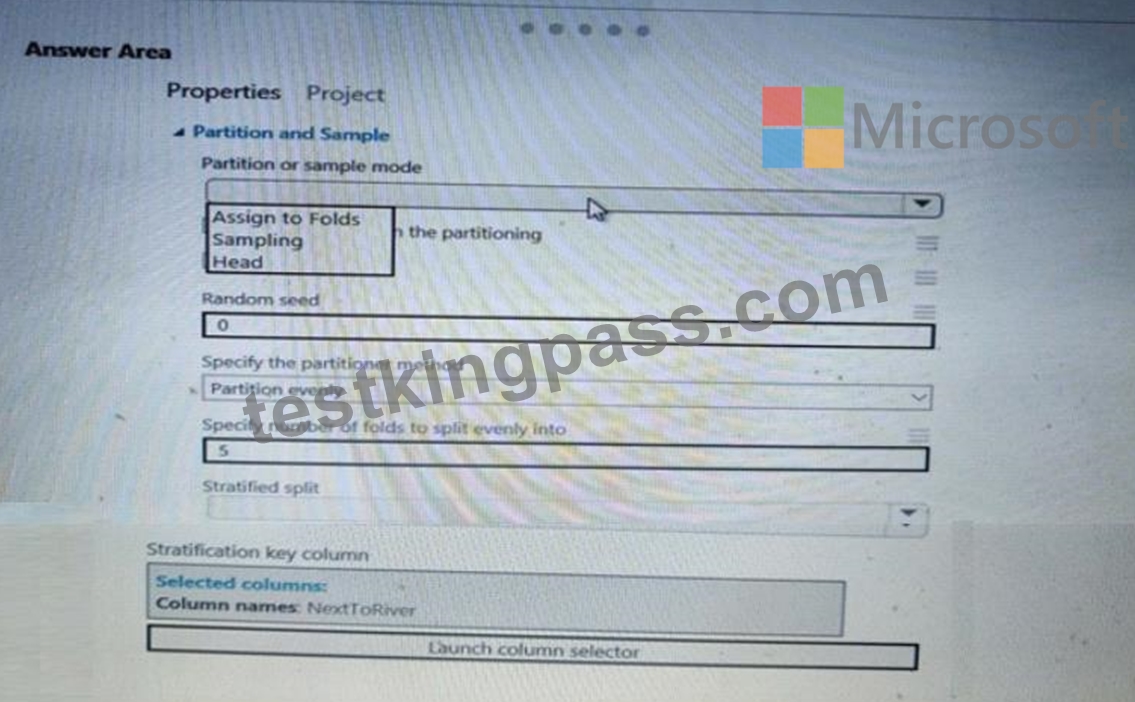
Answer:
Explanation:
NEW QUESTION 127
You are performing a classification task in Azure Machine Learning Studio.
You must prepare balanced testing and training samples based on a provided data set.
You need to split the data with a 0.75:0.25 ratio.
Which value should you use for each parameter? To answer, select the appropriate options in the answer area.
NOTE: Each correct selection is worth one point.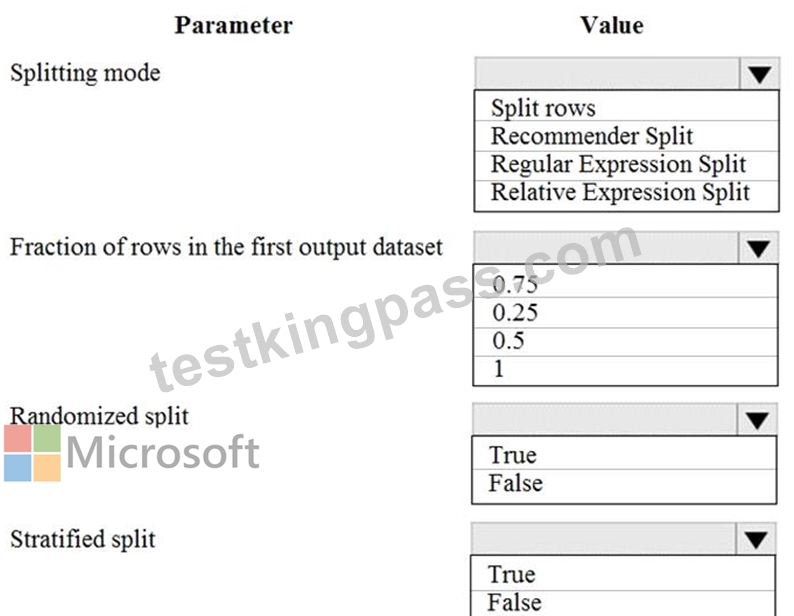
Answer:
Explanation: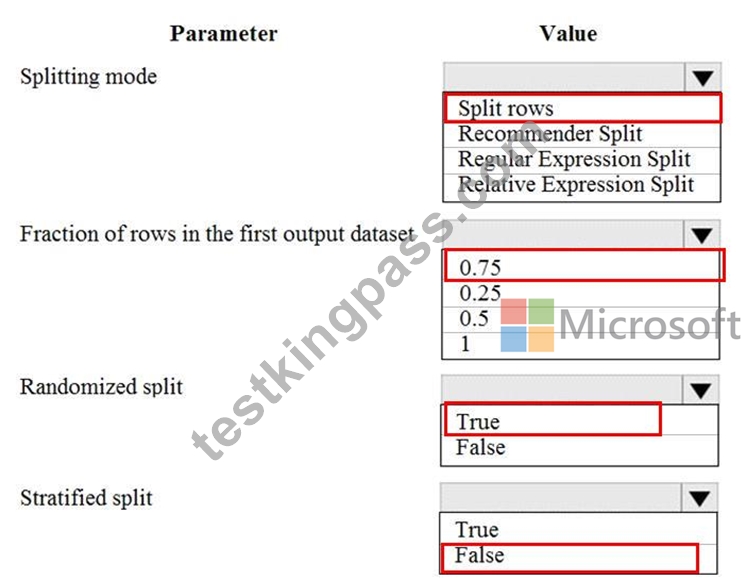
Explanation:
Box 1: Split rows
Use the Split Rows option if you just want to divide the data into two parts. You can specify the percentage of data to put in each split, but by default, the data is divided 50-50.
You can also randomize the selection of rows in each group, and use stratified sampling. In stratified sampling, you must select a single column of data for which you want values to be apportioned equally among the two result datasets.
Box 2: 0.75
If you specify a number as a percentage, or if you use a string that contains the "%" character, the value is interpreted as a percentage. All percentage values must be within the range (0, 100), not including the values 0 and 100.
Box 3: Yes
To ensure splits are balanced.
Box 4: No
If you use the option for a stratified split, the output datasets can be further divided by subgroups, by selecting a strata column.
Reference:
https://docs.microsoft.com/en-us/azure/machine-learning/studio-module-reference/split-data
NEW QUESTION 128
You have a feature set containing the following numerical features: X, Y, and Z.
The Poisson correlation coefficient (r-value) of X, Y, and Z features is shown in the following image:
Use the drop-down menus to select the answer choice that answers each question based on the information presented in the graphic.
NOTE: Each correct selection is worth one point.
Answer:
Explanation:
References:
https://docs.microsoft.com/en-us/azure/machine-learning/studio-module-reference/compute-linear-correlation
NEW QUESTION 129
You are analyzing a dataset containing historical data from a local taxi company. You arc developing a regression a regression model.
You must predict the fare of a taxi trip.
You need to select performance metrics to correctly evaluate the- regression model.
Which two metrics can you use? Each correct answer presents a complete solution.
NOTE: Each correct selection is worth one point.
- A. a Root Mean Square Error value that is low
- B. an R-Squared value close to 0
- C. an F1 score that is high
- D. a Root Mean Square Error value that is high
- E. an F 1 score that is low.
- F. an R Squared value dose to 1
Answer: A,F
Explanation:
Reference:
https://docs.microsoft.com/en-us/azure/machine-learning/studio-module-reference/evaluate-model
NEW QUESTION 130
You run an automated machine learning experiment in an Azure Machine Learning workspace. Information about the run is listed in the table below:
You need to write a script that uses the Azure Machine Learning SDK to retrieve the best iteration of the experiment run. Which Python code segment should you use?
A)
B)
C)
D)
- A. Option D
- B. Option B
- C. Option C
- D. Option A
Answer: A
NEW QUESTION 131
You train and register a model in your Azure Machine Learning workspace.
You must publish a pipeline that enables client applications to use the model for batch inferencing. You must use a pipeline with a single ParallelRunStep step that runs a Python inferencing script to get predictions from the input data.
You need to create the inferencing script for the ParallelRunStep pipeline step.
Which two functions should you include? Each correct answer presents part of the solution.
NOTE: Each correct selection is worth one point.
run(mini_batch)
- A. score(mini_batch)
- B. init()
- C. main()
- D. batch()
Answer: B,C
Explanation:
Explanation/Reference:
https://github.com/Azure/MachineLearningNotebooks/tree/master/how-to-use-azureml/machine-learning- pipelines/parallel-run
NEW QUESTION 132
......
Free DP-100 Exam Dumps to Improve Exam Score: https://prepaway.testkingpass.com/DP-100-testking-dumps.html