


Latest Snowflake ARA-R01 Exam questions and answers
TestkingPass ARA-R01 Exam Practice Test Questions (Updated 163 Questions)
NEW QUESTION # 12
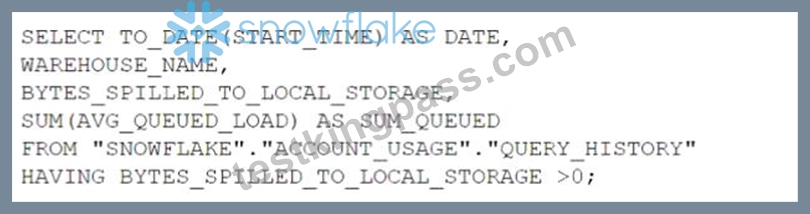
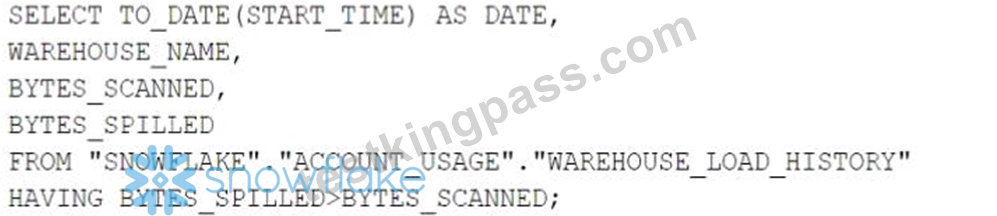
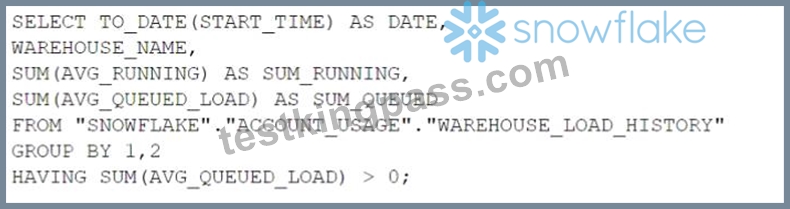
Which query will identify the specific days and virtual warehouses that would benefit from a multi-cluster warehouse to improve the performance of a particular workload?
- A.
- B.
- C.
- D.

Answer: C
Explanation:
The correct answer is option B. This query is designed to assess the need for a multi-cluster warehouse by examining the queuing time (AVG_QUEUED_LOAD) on different days and virtual warehouses. When the AVG_QUEUED_LOAD is greater than zero, it suggests that queries are waiting for resources, which can be an indicator that performance might be improved by using a multi-cluster warehouse to handle the workload more efficiently. By grouping by date and warehouse name and filtering on the sum of the average queued load being greater than zero, the query identifies specific days and warehouses where the workload exceeded the available compute resources. This information is valuable when considering scaling out warehouses to multi-cluster configurations for improved performance.
NEW QUESTION # 13
An Architect is troubleshooting a query with poor performance using the QUERY function. The Architect observes that the COMPILATION_TIME Is greater than the EXECUTION_TIME.
What is the reason for this?
- A. The query Is queued for execution.
- B. The query Is reading from remote storage
- C. The query has overly complex logic.
- D. The query is processing a very large dataset.
Answer: C
Explanation:
* The correct answer is B because the compilation time is the time it takes for the optimizer to create an
* optimal query plan for the efficient execution of the query. The compilation time depends on the complexity of the query, such as the number of tables, columns, joins, filters, aggregations, subqueries, etc. The more complex the query, the longer it takes to compile.
* Option A is incorrect because the query processing time is not affected by the size of the dataset, but by the size of the virtual warehouse. Snowflake automatically scales the compute resources to match the data volume and parallelizes the query execution. The size of the dataset may affect the execution time, but not the compilation time.
* Option C is incorrect because the query queue time is not part of the compilation time or the execution time. It is a separate metric that indicates how long the query waits for a warehouse slot before it starts running. The query queue time depends on the warehouse load, concurrency, and priority settings.
* Option D is incorrect because the query remote IO time is not part of the compilation time or the execution time. It is a separate metric that indicates how long the query spends reading data from remote storage, such as S3 or Azure Blob Storage. The query remote IO time depends on the network latency, bandwidth, and caching efficiency. References:
* Understanding Why Compilation Time in Snowflake Can Be Higher than Execution Time: This article explains why the total duration (compilation + execution) time is an essential metric to measure query performance in Snowflake. It discusses the reasons for the long compilation time, including query complexity and the number of tables and columns.
* Exploring Execution Times: This document explains how to examine the past performance of queries and tasks using Snowsight or by writing queries against views in the ACCOUNT_USAGE schema. It also describes the different metrics and dimensions that affect query performance, such as duration, compilation, execution, queue, and remote IO time.
* What is the "compilation time" and how to optimize it?: This community post provides some tips and best practices on how to reduce the compilation time, such as simplifying the query logic, using views or common table expressions, and avoiding unnecessary columns or joins.
NEW QUESTION # 14
A Snowflake Architect created a new data share and would like to verify that only specific records in secure views are visible within the data share by the consumers.
What is the recommended way to validate data accessibility by the consumers?
- A. Create a row access policy as shown below and assign it to the data share.
create or replace row access policy rap_acct as (acct_id varchar) returns boolean -> case when
'acctl_role' = current_role() then true else false end; - B. Alter the share settings as shown below, in order to impersonate a specific consumer account.
alter share sales share set accounts = 'Consumerl' share restrictions = true - C. Set the session parameter called SIMULATED_DATA_SHARING_C0NSUMER as shown below in order to impersonate the consumer accounts.
alter session set simulated_data_sharing_consumer - 'Consumer Acctl* - D. Create reader accounts as shown below and impersonate the consumers by logging in with their credentials.
create managed account reader_acctl admin_name = userl , adroin_password 'Sdfed43da!44T , type = reader;
Answer: C
Explanation:
The SIMULATED_DATA_SHARING_CONSUMER session parameter allows a data provider to simulate the data access of a consumer account without creating a reader account or logging in with the consumer credentials. This parameter can be used to validate the data accessibility by the consumers in a data share, especially when using secure viewsor secure UDFs that filter data based on the current account or role. By setting this parameter to the name of a consumer account, the data provider can see the same data as the consumer would see when querying the shared database. This is a convenient and efficient way to test the data sharing functionality and ensure that only the intended data is visible to the consumers.
References:
Using the SIMULATED_DATA_SHARING_CONSUMER Session Parameter
SnowPro Advanced: Architect Exam Study Guide
NEW QUESTION # 15
An Architect has a design where files arrive every 10 minutes and are loaded into a primary database table using Snowpipe. A secondary database is refreshed every hour with the latest data from the primary database.
Based on this scenario, what Time Travel query options are available on the secondary database?
- A. Using Time Travel, secondary database users can query every iterative version within each hour (the individual Snowpipe loads) and outside the retention window.
- B. Using Time Travel, secondary database users can query every iterative version within each hour (the individual Snowpipe loads) in the retention window.
- C. A query using Time Travel in the secondary database is available for every hourly table version within the retention window.
- D. A query using Time Travel in the secondary database is available for every hourly table version within and outside the retention window.
Answer: C
Explanation:
Snowflake's Time Travel feature allows users to query historical data within a defined retention period. In the given scenario, since the secondary database is refreshed every hour, Time Travel can be used to query each hourly version of the table as long as it falls within the retention window. This does not include individual Snowpipe loads within each hour unless they coincide with the hourly refresh.
References: The answer is verified using Snowflake's official documentation, which provides detailed information on Time Travel and its usage within the retention period123.
NEW QUESTION # 16
A Snowflake Architect is designing a multi-tenant application strategy for an organization in the Snowflake Data Cloud and is considering using an Account Per Tenant strategy.
Which requirements will be addressed with this approach? (Choose two.)
- A. Tenant data shape may be unique per tenant.
- B. Security and Role-Based Access Control (RBAC) policies must be simple to configure.
- C. Compute costs must be optimized.
- D. Storage costs must be optimized.
- E. There needs to be fewer objects per tenant.
Answer: A,B
Explanation:
The Account Per Tenant strategy involves creating separate Snowflake accounts for each tenant within the multi-tenant application. This approach offers a number of advantages.
Option B: With separate accounts, each tenant's environment is isolated, making security and RBAC policies simpler to configure and maintain. This is because each account can have its own set of roles and privileges without the risk of cross-tenant access or the complexity of maintaining a highly granular permission model within a shared environment.
Option D: This approach also allows for each tenant to have a unique data shape, meaning that the database schema can be tailored to the specific needs of each tenant without affecting others. This can be essential when tenants have different data models, usage patterns, or application customizations.
NEW QUESTION # 17
When activating Tri-Secret Secure in a hierarchical encryption model in a Snowflake account, at what level is the customer-managed key used?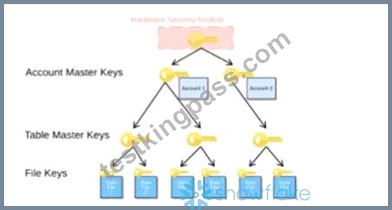
- A. At the table level (TMK)
- B. At the root level (HSM)
- C. At the account level (AMK)
- D. At the micro-partition level
Answer: C
Explanation:
Tri-Secret Secure is a feature that allows customers to use their own key, called the customer-managed key (CMK), in addition to the Snowflake-managed key, to create a composite master key that encrypts the data in Snowflake. The composite master key is also known as the account master key (AMK), as it is unique for each account and encrypts the table master keys (TMKs) that encrypt the file keys that encrypt the data files. The customer-managed key is used at the account level, not at the root level, the table level, or the micro-partition level. The root level is protected by a hardware security module (HSM), the table level is protected by the TMKs, and the micro-partition level is protected by the file keys12. References:
* Understanding Encryption Key Management in Snowflake
* Tri-Secret Secure FAQ for Snowflake on AWS
NEW QUESTION # 18
Which columns can be included in an external table schema? (Select THREE).
- A. METADATAS FILE_ROW_NUMBER
- B. METADATASISUPDATE
- C. VALUE
- D. METADATASROW_ID
- E. METADATASEXTERNAL TABLE PARTITION
- F. METADAT A$ FILENAME
Answer: A,C,F
Explanation:
An external table schema defines the columns and data types of the data stored in an external stage. All external tables include the following columns by default:
VALUE: A VARIANT type column that represents a single row in the external file.
METADATA$FILENAME: A pseudocolumn that identifies the name of each staged data file included in the external table, including its path in the stage.
METADATA$FILE_ROW_NUMBER: A pseudocolumn that shows the row number for each record in a staged data file.
You can also create additional virtual columns as expressions using the VALUE column and/or the pseudocolumns. However, the following columns are not valid for external tables and cannot be included in the schema:
METADATASROW_ID: This column is only available for internal tables and shows the unique identifier for each row in the table.
METADATASISUPDATE: This column is only available for internal tables and shows whether the row was inserted or updated by a merge operation.
METADATASEXTERNAL TABLE PARTITION: This column is not a valid column name and does not exist in Snowflake.
References: Introduction to External Tables, CREATE EXTERNAL TABLE
NEW QUESTION # 19
Which system functions does Snowflake provide to monitor clustering information within a table (Choose two.)
- A. SYSTEM$CLUSTERING_PERCENT
- B. SYSTEM$CLUSTERING_DEPTH
- C. SYSTEM$CLUSTERING_USAGE
- D. SYSTEM$CLUSTERING_KEYS
- E. SYSTEM$CLUSTERING_INFORMATION
Answer: B,E
Explanation:
According to the Snowflake documentation, these two system functions are provided by Snowflake to monitor clustering information within a table. A system function is a type of function that allows executing actions or returning information about the system. A clustering key is a feature that allows organizing data across micro-partitions based on one or more columns in the table. Clustering can improve query performance by reducing the number of files to scan.
SYSTEM$CLUSTERING_INFORMATION is a system function that returns clustering information, including average clustering depth, for a table based on one or more columns in the table. The function takes a table name and an optional column name or expression as arguments, and returns a JSON string with the clustering information. The clustering informationincludes the cluster by keys, the total partition count, the total constant partition count, the average overlaps, and the average depth1.
SYSTEM$CLUSTERING_DEPTH is a system function that returns the clustering depth for a table based on one or more columns in the table. The function takes a table name and an optional column name or expression as arguments, and returns an integer value with the clustering depth. The clustering depth is the maximum number of overlapping micro-partitions for any micro-partition in the table. A lower clustering depth indicates a better clustering2.
References:
SYSTEM$CLUSTERING_INFORMATION | Snowflake Documentation
SYSTEM$CLUSTERING_DEPTH | Snowflake Documentation
NEW QUESTION # 20
Is it possible for a data provider account with a Snowflake Business Critical edition to share data with an Enterprise edition data consumer account?
- A. If a user in the provider account with a share owning role which also has override share restrictions privilege share_restrictions set to False when adding an Enterprise consumer account, it can import the share.
- B. A Business Critical account cannot be a data sharing provider to an Enterprise consumer. Any consumer accounts must also be Business Critical.
- C. If a user in the provider account with a share owning role sets share_restrictions to False when adding an Enterprise consumer account, it can import the share.
- D. If a user in the provider account with role authority to create or alter share adds an Enterprise account as a consumer, it can import the share.
Answer: A
Explanation:
Data sharing is a feature that allows Snowflake accounts to share data with each other without the need for data movement or copying1. Data sharing is enabled by creating shares, which are collections of database objects (tables, views, secure views, and secure UDFs) that can be accessed by other accounts, called consumers2.
By default, Snowflake does not allow sharing data from a Business Critical edition account to a non-Business Critical edition account. This is because Business Critical edition offers higher levels of data protection and encryption than other editions, and sharing data with lower editions may compromise the security and compliance of the data3.
However, Snowflake provides the OVERRIDE SHARE RESTRICTIONS global privilege, which allows a user to override the default restriction and share data from a Business Critical edition account to a non-Business Critical edition account. This privilege is granted to the ACCOUNTADMIN role by default, and can be granted to other roles as well4.
To enable data sharing from a Business Critical edition account to an Enterprise edition account, the following steps are required34:
A user in the provider account with the OVERRIDE SHARE RESTRICTIONS privilege must create or alter a share and add the Enterprise edition account as a consumer. The user must also set the share_restrictions parameter to False when adding the consumer. This parameter indicates whether the share is restricted to Business Critical edition accounts only. Setting it to False allows the share to be imported by lower edition accounts.
A user in the consumer account with the IMPORT SHARE privilege must import the share and grant access to the share objects to other roles in the account. The user must also set the share_restrictions parameter to False when importing the share. This parameter indicates whether the consumer account accepts shares from Business Critical edition accounts only. Setting it to False allows the consumer account to import shares from lower edition accounts.
References:
1: Introduction to Secure Data Sharing | Snowflake Documentation
2: Creating Secure Data Shares | Snowflake Documentation
3: Enable Data Share:Business Critical Account to Lower Edition | Medium
4: Enabling sharing from a Business critical account to a non-business ... | Snowflake Documentation
NEW QUESTION # 21
A company has a source system that provides JSON records for various loT operations. The JSON Is loading directly into a persistent table with a variant field. The data Is quickly growing to 100s of millions of records and performance to becoming an issue. There is a generic access pattern that Is used to filter on the create_date key within the variant field.
What can be done to improve performance?
- A. Incorporate the use of multiple tables partitioned by date ranges. When a user or process needs to query a particular date range, ensure the appropriate base table Is used.
- B. Alter the target table to include additional fields pulled from the JSON records. This would include a create_date field with a datatype of varchar. When this field is used in the filter, partition pruning will occur.
- C. Validate the size of the warehouse being used. If the record count is approaching 100s of millions, size XL will be the minimum size required to process this amount of data.
- D. Alter the target table to Include additional fields pulled from the JSON records. This would Include a create_date field with a datatype of time stamp. When this field Is used in the filter, partition pruning will occur.
Answer: D
Explanation:
The correct answer is A because it improves the performance of queries by reducing the amount of data scanned and processed. By adding a create_date field with a timestamp data type, Snowflake can automatically cluster the table based on this field and prune the micro-partitions that do not match the filter condition. This avoids the need to parse the JSON data and access the variant field for every record.
Option B is incorrect because it does not improve the performance of queries. By adding a create_date field with a varchar data type, Snowflake cannot automatically cluster the table based on this field and prune the micro-partitions that do not match the filter condition. This still requires parsing the JSON data and accessing the variant field for every record.
Option C is incorrect because it does not address the root cause of the performance issue. By validating the size of the warehouse being used, Snowflake can adjust the compute resources to match the data volume and parallelize the query execution. However, this does not reduce the amount of data scanned and processed, which is the main bottleneck for queries on JSON data.
Option D is incorrect because it adds unnecessary complexity and overhead to the data loading and querying process. By incorporating the use of multiple tables partitioned by date ranges, Snowflake can reduce the amount of data scanned and processed for queries that specify a date range. However, this requires creating and maintaining multiple tables, loading data into the appropriate table based on the date, and joining the tables for queries that span multiple date ranges. References:
Snowflake Documentation: Loading Data Using Snowpipe: This document explains how to use Snowpipe to continuously load data from external sources into Snowflake tables. It also describes the syntax and usage of the COPY INTO command, which supports various options and parameters to control the loading behavior, such as ON_ERROR, PURGE, and SKIP_FILE.
Snowflake Documentation: Date and Time Data Types and Functions: This document explains the different data types and functions for working with date and time values in Snowflake. It also describes how to set and change the session timezone and the system timezone.
Snowflake Documentation: Querying Metadata: This document explains how to query the metadata of the objects and operations in Snowflake using various functions, views, and tables. It also describes how to access the copy history information using the COPY_HISTORY function or the COPY_HISTORY view.
Snowflake Documentation: Loading JSON Data: This document explains how to load JSON data into Snowflake tables using various methods, such as the COPY INTO command, the INSERT command, or the PUT command. It also describes how to access and query JSON data using the dot notation, the FLATTEN function, or the LATERAL join.
Snowflake Documentation: Optimizing Storage for Performance: This document explains how to optimize the storage of data in Snowflake tables to improve the performance of queries. It also describes the concepts and benefits of automatic clustering, search optimization service, and materialized views.
NEW QUESTION # 22
What is the MOST efficient way to design an environment where data retention is not considered critical, and customization needs are to be kept to a minimum?
- A. Use a transient schema.
- B. Use a temporary table.
- C. Use a transient table.
- D. Use a transient database.
Answer: D
Explanation:
Transient databases in Snowflake are designed for situations where data retention is not critical, and they do not have the fail-safe period that regular databases have. This means that data in a transient database is not recoverable after the Time Travel retention period. Using a transient database is efficient because it minimizes storage costs while still providing most functionalities of a standard database without the overhead of data protection features that are not needed when data retention is not a concern.
NEW QUESTION # 23
An Architect entered the following commands in sequence:
USER1 cannot find the table.
Which of the following commands does the Architect need to run for USER1 to find the tables using the Principle of Least Privilege? (Choose two.)
- A. GRANT ROLE PUBLIC TO ROLE INTERN;
- B. GRANT USAGE ON DATABASE SANDBOX TO ROLE INTERN;
- C. GRANT OWNERSHIP ON DATABASE SANDBOX TO USER INTERN;
- D. GRANT USAGE ON SCHEMA SANDBOX.PUBLIC TO ROLE INTERN;
- E. GRANT ALL PRIVILEGES ON DATABASE SANDBOX TO ROLE INTERN;
Answer: B,D
Explanation:
* According to the Principle of Least Privilege, the Architect should grant the minimum privileges necessary for the USER1 to find the tables in the SANDBOX database.
* The USER1 needs to have USAGE privilege on the SANDBOX database and the SANDBOX.PUBLIC schema to be able to access the tables in the PUBLIC schema. Therefore, the commands B and C are the correct ones to run.
* The command A is not correct because the PUBLIC role is automatically granted to every user and role in the account, and it does not have any privileges on the SANDBOX database by default.
* The command D is not correct because it would transfer the ownership of the SANDBOX database from the Architect to the USER1, which is not necessary and violates the Principle of Least Privilege.
* The command E is not correct because it would grant all the possible privileges on the SANDBOX database to the USER1, which is also not necessary and violates the Principle of Least Privilege.
References: : Snowflake - Principle of Least Privilege : Snowflake - Access Control Privileges : Snowflake - Public Role : Snowflake - Ownership and Grants
NEW QUESTION # 24
A company's client application supports multiple authentication methods, and is using Okta.
What is the best practice recommendation for the order of priority when applications authenticate to Snowflake?
- A. 1) Password
2) Key Pair Authentication, mostly used for production environment users
3) Okta native authentication
4) OAuth (either Snowflake OAuth or External OAuth)
5) External browser, SSO - B. 1) OAuth (either Snowflake OAuth or External OAuth)
2) External browser
3) Okta native authentication
4) Key Pair Authentication, mostly used for service account users
5) Password - C. 1) Okta native authentication
2) Key Pair Authentication, mostly used for production environment users
3) Password
4) OAuth (either Snowflake OAuth or External OAuth)
5) External browser, SSO - D. 1) External browser, SSO
2) Key Pair Authentication, mostly used for development environment users
3) Okta native authentication
4) OAuth (ether Snowflake OAuth or External OAuth)
5) Password
Answer: B
Explanation:
This is the best practice recommendation for the order of priority when applications authenticate to Snowflake, according to the Snowflake documentation and the web search results. Authentication is the process of verifying the identity of a user or application that connects to Snowflake. Snowflake supports multiple authentication methods, each with different advantages and disadvantages. The recommended order of priority is based on the following factors:
Security: The authentication method should provide a high level of security and protection against unauthorized access or data breaches. The authentication method should also support multi-factor authentication (MFA) or single sign-on (SSO) for additional security.
Convenience: The authentication method should provide a smooth and easy user experience, without requiring complex or manual steps. The authentication method should also support seamless integration with external identity providers or applications.
Flexibility: The authentication method should provide a range of options and features to suit different use cases and scenarios. The authentication method should also support customization and configuration to meet specific requirements.
Based on these factors, the recommended order of priority is:
OAuth (either Snowflake OAuth or External OAuth): OAuth is an open standard for authorization that allows applications to access Snowflake resources on behalf of a user, without exposing the user's credentials. OAuth provides a high level of security, convenience, and flexibility, as it supports MFA, SSO, token-based authentication, and various grant types and scopes. OAuth can be implemented using either Snowflake OAuth or External OAuth, depending on the identity provider and the application12.
External browser: External browser is an authentication method that allows users to log in to Snowflake using a web browser and an external identity provider, such as Okta, Azure AD, or Ping Identity.
External browser provides a high level of security and convenience, as it supports MFA, SSO, and federated authentication. External browser also provides a consistent user interface and experience across different platforms and devices34.
Okta native authentication: Okta native authentication is an authentication method that allows users to log in to Snowflake using Okta as the identity provider, without using a web browser. Okta native authentication provides a high level of security and convenience, as it supports MFA, SSO, and federated authentication. Okta native authentication also provides a native user interface and experience for Okta users, and supports various Okta features, such as password policies and user management56.
Key Pair Authentication: Key Pair Authentication is an authentication method that allows users to log in to Snowflake using a public-private key pair, without using a password. Key Pair Authentication provides a high level of security, as it relies on asymmetric encryption and digital signatures. Key Pair Authentication also provides a flexible and customizable authentication option, as it supports various key formats, algorithms, and expiration times. Key Pair Authentication is mostly used for service account users, such as applications or scripts that connect to Snowflake programmatically7 .
Password: Password is the simplest and most basic authentication method that allows users to log in to Snowflake using a username and password. Password provides a low level of security, as it relies on symmetric encryption and is vulnerable to brute force attacks or phishing. Password also provides a low level of convenience and flexibility, as it requires manual input and management, and does not support MFA or SSO. Password is the least recommended authentication method, and should be used only as a last resort or for testing purposes .
References:
Snowflake Documentation: Snowflake OAuth
Snowflake Documentation: External OAuth
Snowflake Documentation: External Browser Authentication
Snowflake Blog: How to Use External Browser Authentication with Snowflake Snowflake Documentation: Okta Native Authentication Snowflake Blog: How to Use Okta Native Authentication with Snowflake Snowflake Documentation: Key Pair Authentication
[Snowflake Blog: How to Use Key Pair Authentication with Snowflake]
[Snowflake Documentation: Password Authentication]
[Snowflake Blog: How to Use Password Authentication with Snowflake]
NEW QUESTION # 25
A new user user_01 is created within Snowflake. The following two commands are executed:
Command 1-> show grants to user user_01;
Command 2 ~> show grants on user user 01;
What inferences can be made about these commands?
- A. Command 1 defines all the grants which are given to user_01 Command 2 defines which user owns user_01
- B. Command 1 defines which role owns user_01
Command 2 defines all the grants which have been given to user_01 - C. Command 1 defines which user owns user_01
Command 2 defines all the grants which have been given to user_01 - D. Command 1 defines all the grants which are given to user_01
Command 2 defines which role owns user 01
Answer: D
Explanation:
The SHOW GRANTS command in Snowflake can be used to list all the access control privileges that have been explicitly granted to roles, users, and shares. The syntax and the output of the command vary depending on the object type and the grantee type specified in the command1. In this question, the two commands have the following meanings:
Command 1: show grants to user user_01; This command lists all the roles granted to the user user_01.
The output includes the role name, the grantee name, and the granted by role name for each grant. This command is equivalent to show grants to user current_user if user_01 is the current user1.
Command 2: show grants on user user_01; This command lists all the privileges that have been granted on the user object user_01. The output includes the privilege name, the grantee name, and the granted by role name for each grant. This command shows which role owns the user object user_01, as the owner role has the privilege to modify or drop the user object2.
Therefore, the correct inference is that command 1 defines all the grants which are given to user_01, and command 2 defines which role owns user_01.
References:
SHOW GRANTS
Understanding Access Control in Snowflake
NEW QUESTION # 26
A user can change object parameters using which of the following roles?
- A. ACCOUNTADMIN, SECURITYADMIN
- B. SECURITYADMIN, USER with PRIVILEGE
- C. ACCOUNTADMIN, USER with PRIVILEGE
- D. SYSADMIN, SECURITYADMIN
Answer: C
Explanation:
According to the Snowflake documentation, object parameters are parameters that can be set on individual objects such as databases, schemas, tables, and stages. Object parameters can be set by users with the appropriate privileges on the objects. For example, to set the object parameter AUTO_REFRESH on a table, the user must have the MODIFY privilege on the table. The ACCOUNTADMIN role has the highest level of privileges on all objects in the account, so it can set any object parameter on any object. However, other roles, such as SECURITYADMIN or SYSADMIN, do not have the same level of privileges on all objects, so they cannot set object parameters on objects they do not own or have the required privileges on. Therefore, the correct answer is C. ACCOUNTADMIN, USER with PRIVILEGE.
References:
* Parameters | Snowflake Documentation
* Object Parameters | Snowflake Documentation
* Object Privileges | Snowflake Documentation
NEW QUESTION # 27
A global company needs to securely share its sales and Inventory data with a vendor using a Snowflake account.
The company has its Snowflake account In the AWS eu-west 2 Europe (London) region. The vendor's Snowflake account Is on the Azure platform in the West Europe region. How should the company's Architect configure the data share?
- A. 1. Promote an existing database in the company's local account to primary.
2. Replicate the database to Snowflake on Azure in the West-Europe region.
3. Create a share and add objects to the share.
4. Add a consumer account to the share for the vendor to access. - B. 1. Create a share.
2. Create a reader account for the vendor to use.
3. Add the reader account to the share. - C. 1. Create a new role called db_share.
2. Grant the db_share role privileges to read data from the company database and schema.
3. Create a user for the vendor.
4. Grant the ds_share role to the vendor's users. - D. 1. Create a share.
2. Add objects to the share.
3. Add a consumer account to the share for the vendor to access.
Answer: D
Explanation:
The correct way to securely share data with a vendor using a Snowflake account on a different cloud platform and region is to create a share, add objects to the share, and add a consumer account to the share for the vendor to access. This way, the company can control what data is shared, who can access it, and how long the share is valid. The vendor can then query the shared data without copying or moving it to their own account. The other options are either incorrect or inefficient, as they involve creating unnecessary reader accounts, users, roles, or database replication.
https://learn.snowflake.com/en/certifications/snowpro-advanced-architect/
NEW QUESTION # 28
What transformations are supported in the below SQL statement? (Select THREE).
CREATE PIPE ... AS COPY ... FROM (...)
- A. The ON ERROR - ABORT statement command can be used.
- B. Incoming data can be joined with other tables.
- C. Type casts are supported.
- D. Columns can be omitted.
- E. Data can be filtered by an optional where clause.
- F. Columns can be reordered.
Answer: D,E,F
Explanation:
The SQL statement is a command for creating a pipe in Snowflake, which is an object that defines the COPY INTO <table> statement used by Snowpipe to load data from an ingestion queue into tables1. The statement uses a subquery in the FROM clause to transform the data from the staged files before loading it into the table2.
The transformations supported in the subquery are as follows2:
Data can be filtered by an optional WHERE clause, which specifies a condition that must be satisfied by the rows returned by the subquery. For example:
SQLAI-generated code. Review and use carefully. More info on FAQ.
createpipe mypipeas
copyintomytable
from(
select*from@mystage
wherecol1='A'andcol2>10
);
Columns can be reordered, which means changing the order of the columns in the subquery to match the order of the columns in the target table. For example:
SQLAI-generated code. Review and use carefully. More info on FAQ.
createpipe mypipeas
copyintomytable (col1, col2, col3)
from(
selectcol3, col1, col2from@mystage
);
Columns can be omitted, which means excluding some columns from the subquery that are not needed in the target table. For example:
SQLAI-generated code. Review and use carefully. More info on FAQ.
createpipe mypipeas
copyintomytable (col1, col2)
from(
selectcol1, col2from@mystage
);
The other options are not supported in the subquery because2:
Type casts are not supported, which means changing the data type of a column in the subquery.
For example, the following statement will cause an error:
SQLAI-generated code. Review and use carefully. More info on FAQ.
createpipe mypipeas
copyintomytable (col1, col2)
from(
selectcol1::date, col2from@mystage
);
Incoming data can not be joined with other tables, which means combining the data from the staged files with the data from another table in the subquery. For example, the following statement will cause an error:
SQLAI-generated code. Review and use carefully. More info on FAQ.
createpipe mypipeas
copyintomytable (col1, col2, col3)
from(
selects.col1, s.col2, t.col3from@mystages
joinothertable tons.col1=t.col1
);
The ON ERROR - ABORT statement command can not be used, which means aborting the entire load operation if any error occurs. This command can only be used in the COPY INTO <table> statement, not in the subquery. For example, the following statement will cause an error:
SQLAI-generated code. Review and use carefully. More info on FAQ.
createpipe mypipeas
copyintomytable
from(
select*from@mystage
onerror abort
);
References:
1: CREATE PIPE | Snowflake Documentation
2: Transforming Data During a Load | Snowflake Documentation
NEW QUESTION # 29
Which of the following are characteristics of Snowflake's parameter hierarchy?
- A. Schema parameters override account parameters.
- B. Table parameters override virtual warehouse parameters.
- C. Virtual warehouse parameters override user parameters.
- D. Session parameters override virtual warehouse parameters.
Answer: C
Explanation:
In Snowflake's parameter hierarchy, virtual warehouse parameters take precedence over user parameters. This hierarchy is designed to ensure that settings at the virtual warehouse level, which typically reflect the requirements of a specific workload or set of queries, override the preferences set at the individual user level.
This helps maintain consistent performance and resource utilization as specified by the administrators managing the virtual warehouses.References: Snowflake documentation on parameter hierarchy, found in the SnowPro Advanced: Architect learning materials.
NEW QUESTION # 30
What Snowflake features should be leveraged when modeling using Data Vault?
- A. Scaling up the virtual warehouses will support parallel processing of new source loads
- B. Snowflake's ability to hash keys so that hash key joins can run faster than integer joins
- C. Data needs to be pre-partitioned to obtain a superior data access performance
- D. Snowflake's support of multi-table inserts into the data model's Data Vault tables
Answer: A,D
Explanation:
These two features are relevant for modeling using Data Vault on Snowflake. Data Vault is a data modeling approach that organizes data into hubs, links, and satellites. Data Vault is designed to enable high scalability, flexibility, and performance for data integration and analytics. Snowflake is a cloud data platform that supports various data modeling techniques, including Data Vault. Snowflake provides some features that can enhance the Data Vault modeling, such as:
Snowflake's support of multi-table inserts into the data model's Data Vault tables. Multi-table inserts (MTI) are a feature that allows inserting data from a single query into multiple tables in a single DML statement. MTI can improve the performance and efficiency of loading datainto Data Vault tables, especially for real-time or near-real-time data integration. MTI can also reduce the complexity and maintenance of the loading code, as well as the data duplication and latency12.
Scaling up the virtual warehouses will support parallel processing of new source loads. Virtual warehouses are a feature that allows provisioning compute resources on demand for data processing.
Virtual warehouses can be scaled up or down by changing the size of the warehouse, which determines the number of servers in the warehouse. Scaling up the virtual warehouses can improve the performance and concurrency of processing new source loads into Data Vault tables, especially for large or complex data sets. Scaling up the virtual warehouses can also leverage the parallelism and distribution of Snowflake's architecture, which can optimize the data loading and querying34.
References:
Snowflake Documentation: Multi-table Inserts
Snowflake Blog: Tips for Optimizing the Data Vault Architecture on Snowflake Snowflake Documentation: Virtual Warehouses Snowflake Blog: Building a Real-Time Data Vault in Snowflake
NEW QUESTION # 31
An Architect is troubleshooting a query with poor performance using the QUERY_HIST0RY function. The Architect observes that the COMPILATIONJHME is greater than the EXECUTIONJTIME.
What is the reason for this?
- A. The query has overly complex logic.
- B. The query is queued for execution.
- C. The query is reading from remote storage.
- D. The query is processing a very large dataset.
Answer: A
Explanation:
Compilation time is the time it takes for the optimizer to create an optimal query plan for the efficient execution of the query. It also involves some pruning of partition files, making the query execution efficient2 If the compilation time is greater than the execution time, it means that the optimizer spent more time analyzing the query than actually running it. This could indicate that the query has overly complex logic, such as multiple joins, subqueries, aggregations, or expressions. The complexity of the query could also affect the size and quality of the query plan, which could impact the performance of the query3 To reduce the compilation time, the Architect can try to simplify the query logic, use views or common table expressions (CTEs) to break down the query into smaller parts, or use hints to guide the optimizer. The Architect can also use the EXPLAIN command to examine the query plan and identify potential bottlenecks or inefficiencies4 References:
1: SnowPro Advanced: Architect | Study Guide 5
2: Snowflake Documentation | Query Profile Overview 6
3: Understanding Why Compilation Time in Snowflake Can Be Higher than Execution Time 7
4: Snowflake Documentation | Optimizing Query Performance 8
: SnowPro Advanced: Architect | Study Guide
: Query Profile Overview
: Understanding Why Compilation Time in Snowflake Can Be Higher than Execution Time
: Optimizing Query Performance
NEW QUESTION # 32
An Architect runs the following SQL query: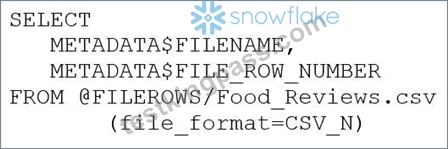
How can this query be interpreted?
- A. FILEROWS is a file. FILE_ROW_NUMBER is the file format location.
- B. FILEROWS is a stage. FILE_ROW_NUMBER is line number in file.
- C. FILEROWS is the table. FILE_ROW_NUMBER is the line number in the table.
- D. FILERONS is the file format location. FILE_ROW_NUMBER is a stage.
Answer: B
Explanation:
A stage is a named location in Snowflake that can store files for data loading and unloading. A stage can be internal or external, depending on where the files are stored.
The query in the question uses the LIST function to list the files in a stage named FILEROWS. The function returns a table with various columns, including FILE_ROW_NUMBER, which is the line number of the file in the stage.
Therefore, the query can be interpreted as listing the files in a stage named FILEROWS and showing the line number of each file in the stage.
References:
: Stages
: LIST Function
NEW QUESTION # 33
What are some of the characteristics of result set caches? (Choose three.)
- A. Snowflake persists the data results for 24 hours.
- B. Time Travel queries can be executed against the result set cache.
- C. The retention period can be reset for a maximum of 31 days.
- D. The data stored in the result cache will contribute to storage costs.
- E. Each time persisted results for a query are used, a 24-hour retention period is reset.
- F. The result set cache is not shared between warehouses.
Answer: A,C,E
Explanation:
Comprehensive and Detailed Explanation: According to the SnowPro Advanced: Architect documents and learning resources, some of the characteristics of result set caches are:
Snowflake persists the data results for 24 hours. This means that the result set cache holds the results of every query executed in the past 24 hours, and can be reused if the same query is submitted again and the underlying data has not changed1.
Each time persisted results for a query are used, a 24-hour retention period is reset. This means that the result set cache extends the lifetime of the results every time they are reused, up to a maximum of 31 days from the date and time that the query was first executed1.
The retention period can be reset for a maximum of 31 days. This means that the result set cache will purge the results after 31 days, regardless of whether they are reused or not. After 31 days, the next time the query is submitted, a new result is generated and persisted1.
The other options are incorrect because they are not characteristics of result set caches. Option A is incorrect because Time Travel queries cannot be executed against the result set cache. Time Travel queries use the AS OF clause to access historical data that is stored in the storage layer, not the result set cache2. Option D is incorrect because the data stored in the result set cache does not contribute to storage costs. The result set cache is maintained by the service layer, and does not incurany additional charges1. Option F is incorrect because the result set cache is shared between warehouses. The result set cache is available across virtual warehouses, so query results returned to one user are available to any other user on the system who executes the same query, provided the underlying data has not changed1. References: Using Persisted Query Results | Snowflake Documentation, Time Travel | Snowflake Documentation
NEW QUESTION # 34
An Architect has been asked to clone schema STAGING as it looked one week ago, Tuesday June 1st at 8:00 AM, to recover some objects.
The STAGING schema has 50 days of retention.
The Architect runs the following statement:
CREATE SCHEMA STAGING_CLONE CLONE STAGING at (timestamp => '2021-06-01 08:00:00'); The Architect receives the following error: Time travel data is not available for schema STAGING. The requested time is either beyond the allowed time travel period or before the object creation time.
The Architect then checks the schema history and sees the following:
CREATED_ON|NAME|DROPPED_ON
2021-06-02 23:00:00 | STAGING | NULL
2021-05-01 10:00:00 | STAGING | 2021-06-02 23:00:00
How can cloning the STAGING schema be achieved?
- A. Cloning cannot be accomplished because the STAGING schema version was not active during the proposed Time Travel time period.
- B. Modify the statement: CREATE SCHEMA STAGING_CLONE CLONE STAGING at (timestamp =>
'2021-05-01 10:00:00'); - C. Rename the STAGING schema and perform an UNDROP to retrieve the previous STAGING schema version, then run the CLONE statement.
- D. Undrop the STAGING schema and then rerun the CLONE statement.
Answer: A
Explanation:
The error encountered during the cloning attempt arises because the schema STAGING as it existed on June
1st, 2021, is not within the Time Travel retention period. According to the schema history, STAGING was recreated on June 2nd, 2021, after being dropped on the same day. The requested timestamp of '2021-06-01
08:00:00' is prior to this recreation, hence not available. The STAGING schema from before June 2nd was dropped and exceeded the Time Travel period for retrieval by the time of the cloning attempt. Therefore, cloning STAGING as it looked on June 1st, 2021, cannot be achieved because the data from that time is no longer available within the allowed Time Travel window.References: Snowflake documentation on Time Travel and data cloning, which is covered under the SnowPro Advanced: Architect certification resources.
NEW QUESTION # 35
......
Snowflake ARA-R01 Exam Syllabus Topics:
| Topic | Details |
|---|---|
| Topic 1 |
|
| Topic 2 |
|
| Topic 3 |
|
| Topic 4 |
|
Pass Your Snowflake Exam with ARA-R01 Exam Dumps: https://prepaway.testkingpass.com/ARA-R01-testking-dumps.html