


MuleSoft MCIA-Level-1-Maintenance Exam Preparation Guide and PDF Download
Verified & Correct MCIA-Level-1-Maintenance Practice Test Reliable Source Dec 30, 2023 Updated
The MCIA-Level-1-Maintenance exam validates the candidate's ability to design, build, and manage integration solutions using MuleSoft's Anypoint Platform. MCIA-Level-1-Maintenance exam is ideal for integration architects, developers, and technical leads who are responsible for creating and maintaining integration solutions using MuleSoft. MuleSoft Certified Integration Architect - Level 1 MAINTENANCE certification demonstrates the candidate's proficiency in MuleSoft's latest technologies and best practices and enhances their credibility as an integration expert. MuleSoft Certified Integration Architect - Level 1 MAINTENANCE certification is valid for two years, after which candidates must pass the maintenance exam to retain their certification.
NEW QUESTION # 35
The ABC company has an Anypoint Runtime Fabric on VMs/Bare Metal (RTF-VM) appliance installed on its own customer-hosted AWS infrastructure.
Mule applications are deployed to this RTF-VM appliance. As part of the company standards, the Mule application logs must be forwarded to an external log management tool (LMT).
Given the company's current setup and requirements, what is the most idiomatic (used for its intended purpose) way to send Mule application logs to the external LMT?
- A. In RTF-VM. configure the out-of-the-box external log forwarder
- B. In each Mule application, configure custom Log4j settings
- C. In RTF-VM, edit the pod configuration to automatically install and configure an Anypoint Monitoring agent
- D. In RTF-VM, install and configure the external LTM's log-forwarding agent
Answer: D
NEW QUESTION # 36
A customer wants to use the mapped diagnostic context (MDC) and logging variables to enrich its logging and improve tracking by providing more context in the logs.
The customer also wants to improve the throughput and lower the latency of message processing.
As an Mulesoft integration architect can you advise, what should the customer implement to meet these requirements?
- A. Useasync logger at the level greater than INFO and use pattern layout with [%MDC] in the log4j2,xml configuration file and then configure the logging variables
- B. Use synchronous logging at the INFO DEBUG or Trace level and use pattern layout with
[%MDC] in the log4j2.xml configuration file and then configure the logging variables - C. Useasync logger at the level equal to DEBUG orTRACEand use pattern
layout with [%MDC] in the log4j2.xml configuration file and then configure the logging variables - D. Use synchronous logging and use pattern layout with [%MDC] in the log4j2.xml configuration file and then configure the logging variables
Answer: A
NEW QUESTION # 37
A Mule application is built to support a local transaction for a series of operations on a single database. The mule application has a Scatter-Gather scope that participates in the local transaction.
What is the behavior of the Scatter-Gather when running within this local transaction?
- A. Execution of all routes within Scatter-Gather occurs in parallel Any error that occurs inside Scatter-Gather will result in a roll back of all the database operations
- B. Execution of all routes within Scatter-Gather occurs sequentially Any error that occurs inside Scatter-Gather will be handled by error handler and will not result in roll back
- C. Execution of all routes within Scatter-Gather occurs sequentially Any error that occurs inside Scatter-Gather will result in a roll back of all the database operations
- D. Execution of all routes within Scatter-Gather occurs in parallel Any error that occurs inside Scatter-Gather will be handled by error handler and will not result in roll back
Answer: A
NEW QUESTION # 38
A finance giant is planning to migrate all its Mule applications to Runtime fabric (RTF). Currently all Mule applications are deployed cloud hub using automated CI/CD scripts.
As an integration architect, which of the below step would you suggest to ensure that the applications from cloudhub are migrated properly to Runtime Fabric (RTF) with an assumption that organization is keen on keeping the same deployment strategy.
- A. runtimeFabric deployment should be added to POM.xml file in all
the mule applications and CI/CD script should be modified as per the RTF configurations - B. runtimeFabric profile should be added mule configuration files in the mule applications and CI/CD script should be modified as per the RTF configurations
- C. runtimeFabric dependency should be added as a mule plug-in to POM.xml file and CI/CD script should be modified as per the RTF configurations
- D. No changes need to be made to POM.xml file and CI/CD script should be modified as per the RTF configurations
Answer: A
NEW QUESTION # 39
As a part of project requirement, client will send a stream of data to mule application. Payload size can vary between 10mb to 5GB. Mule application is required to transform the data and send across multiple sftp servers. Due to the cost cuttings in the organization, mule application can only be allocated one worker with size of 0.2 vCore.
As an integration architect , which streaming strategy you would suggest to handle this scenario?
- A. In-memory repeatable stream
- B. In-memory non repeatable stream
- C. File based non-repeatable stream
- D. File based repeatable storage
Answer: D
Explanation:
Explanation
As the question says that data needs to be sent across multiple sftp serves , we cannot use non-repeatable streams. The non-repeatable strategy disables repeatable streams, which enables you to read an input stream only once.
You cant use in memory storage because with 0.2 vcore you will get only 1 GB of heap memory. Hence application will error out for file more than 1 GB.
Hence the correct option is file base repeatable stream
NEW QUESTION # 40
A mule application designed to fulfil two requirements
a) Processing files are synchronously from an FTPS server to a back-end database using VM intermediary queues for load balancing VM events b) Processing a medium rate of records from a source to a target system using batch job scope Considering the processing reliability requirements for FTPS files, how should VM queues be configured for processing files as well as for the batch job scope if the application is deployed to Cloudhub workers?
- A. Use VM connector persistent queues for FTPS file processing Disable VM queue for the batch job scope
- B. Use Cloud hub persistent queues for FTPS files processing
There is no need to configure VM queues for the batch jobs scope as it uses by default the worker's disc for VM queueing - C. Use Cloud hub persistent VM queues for FTPS file processing
Disable VM queue for the batch job scope - D. Use Cloud hub persistent VM queue for FTPS file processing
There is no need to configure VM queues for the batch jobs scope as it uses by default the worker's JVM memory for VM queueing
Answer: C
NEW QUESTION # 41
An API has been updated in Anypoint Exchange by its API producer from version 3.1.1 to 3.2.0 following accepted semantic versioning practices and the changes have been communicated via the API's public portal.
The API endpoint does NOT change in the new version. How should the developer of an API client respond to this change?
- A. The API client code ONLY needs to be changed if it needs to take advantage of new features.
- B. The API producer should be requested to run the old version in parallel with the new one.
- C. The API producer should be contacted to understand the change to existing functionality.
- D. The update should be identified as a project risk and full regression testing of the functionality that uses this API should be run.
Answer: A
Explanation:
Explanation
* Semantic Versioning is a 3-component number in the format of X.Y.Z, where :
X stands for a major version.
Y stands for a minor version:
Z stands for a patch.
So, SemVer is of the form Major.Minor.Patch Coming to our question , minor version of the API has been changed which is backward compatible. Hence there is no change required on API client end. If they want to make use of new featured that have been added as a part of minor version change they may need to change code at their end. Hence correct answer is The API client code ONLY needs to be changed if it needs to take advantage of new features.
Diagram Description automatically generated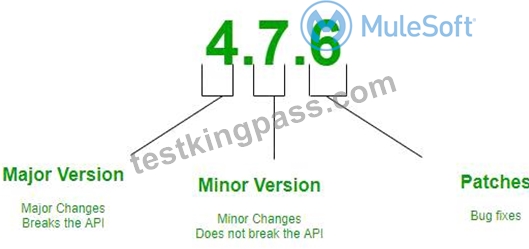
NEW QUESTION # 42
An automation engineer needs to write scripts to automate the steps of the API lifecycle, including steps to create, publish, deploy and manage APIs and their implementations in Anypoint Platform.
What Anypoint Platform feature can be used to automate the execution of all these actions in scripts in the easiest way without needing to directly invoke the Anypoint Platform REST APIs?
- A. Automated Policies in API Manager
- B. Runtime Manager agent
- C. The Mule Maven Plugin
- D. Anypoint CLI
Answer: D
Explanation:
Explanation
Anypoint Platform provides a scripting and command-line tool for both Anypoint Platform and Anypoint Platform Private Cloud Edition (Anypoint Platform PCE). The command-line interface (CLI) supports both the interactive shell and standard CLI modes and works with: Anypoint Exchange Access management Anypoint Runtime Manager
NEW QUESTION # 43
A leading bank implementing new mule API.
The purpose of API to fetch the customer account balances from the backend application and display them on the online platform the online banking platform. The online banking platform will send an array of accounts to Mule API get the account balances.
As a part of the processing the Mule API needs to insert the data into the database for auditing purposes and this process should not have any performance related implications on the account balance retrieval flow How should this requirement be implemented to achieve better throughput?
- A. Implement a for each scope to fetch the data from the back-end application and to insert records into the Audit database
- B. Implement a try-catch scope to fetch the data from the back-end application and use the Async scope to insert records into the Audit database
- C. Implement the Async scope fetch the data from the backend application and to insert records in the Audit database
- D. Implement parallel for each scope to fetch the data from the backend application and use Async scope to insert the records into the Audit database
Answer: D
NEW QUESTION # 44
An organization needs to enable access to their customer data from both a mobile app and a web application, which each need access to common fields as well as certain unique fields. The data is available partially in a database and partially in a 3rd-party CRM system. What APIs should be created to best fit these design requirements?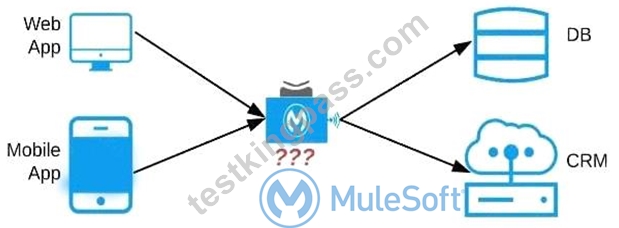
- A. Separate Experience APIs for the mobile and web app, but a common Process API that invokes separate System APIs created for the database and CRM system
- B. A Process API that contains the data required by both the web and mobile apps, allowing these applications to invoke it directly and access the data they need thereby providing the flexibility to add more fields in the future without needing API changes.
- C. One set of APIs (Experience API, Process API, and System API) for the web app, and another set for the mobile app.
- D. A common Experience API used by both the web and mobile apps, but separate Process APIs for the web and mobile apps that interact with the database and the CRM System.
Answer: A
Explanation:
Explanation
Lets analyze the situation in regards to the different options available Option : A common Experience API but separate Process APIs Analysis : This solution will not work because having common experience layer will not help the purpose as mobile and web applications will have different set of requirements which cannot be fulfilled by single experience layer API Option : Common Process API Analysis : This solution will not work because creating a common process API will impose limitations in terms of flexibility to customize API;s as per the requirements of different applications. It is not a recommended approach.
Option : Separate set of API's for both the applications Analysis : This goes against the principle of Anypoint API-led connectivity approach which promotes creating reusable assets. This solution may work but this is not efficient solution and creates duplicity of code.
Hence the correct answer is: Separate Experience APIs for the mobile and web app, but a common Process API that invokes separate System APIs created for the database and CRM system A screenshot of a computer Description automatically generated with low confidence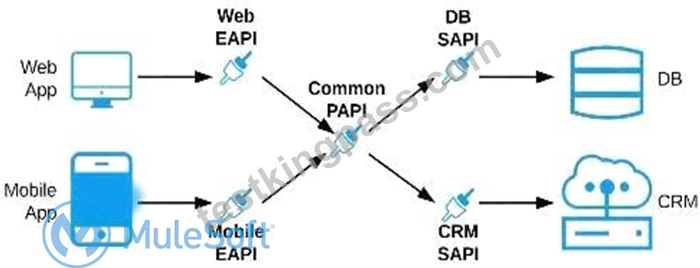
Lets analyze the situation in regards to the different options available Option : A common Experience API but separate Process APIs Analysis : This solution will not work because having common experience layer will not help the purpose as mobile and web applications will have different set of requirements which cannot be fulfilled by single experience layer API Option : Common Process API Analysis : This solution will not work because creating a common process API will impose limitations in terms of flexibility to customize API;s as per the requirements of different applications. It is not a recommended approach.
Option : Separate set of API's for both the applications Analysis : This goes against the principle of Anypoint API-led connectivity approach which promotes creating reusable assets. This solution may work but this is not efficient solution and creates duplicity of code.
Hence the correct answer is: Separate Experience APIs for the mobile and web app, but a common Process API that invokes separate System APIs created for the database and CRM system Diagram Description automatically generated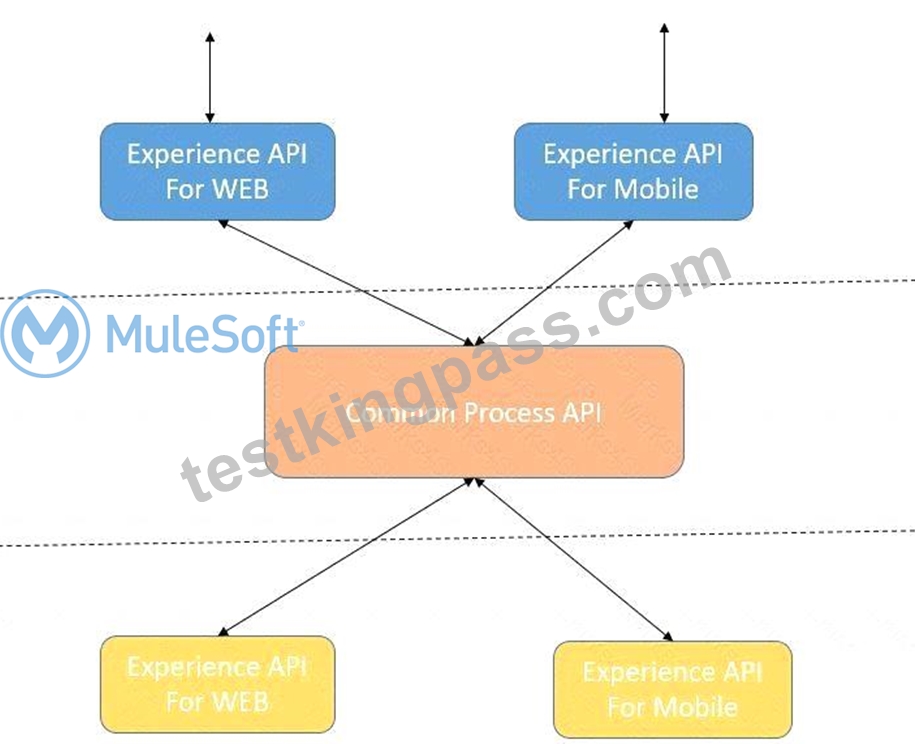
NEW QUESTION # 45
A mule application is required to periodically process large data set from a back-end database to Salesforce CRM using batch job scope configured properly process the higher rate of records.
The application is deployed to two cloudhub workers with no persistence queues enabled.
What is the consequence if the worker crashes during records processing?
- A. Remaining records will be left and processed
- B. All the records will be processed from scratch by the second worker leading to duplicate processing
- C. Remaining records will be processed by a new replacement worker
- D. Remaining records be processed by second worker
Answer: A
NEW QUESTION # 46
Organization wants to achieve high availability goal for Mule applications in customer hosted runtime plane.
Due to the complexity involved, data cannot be shared among of different instances of same Mule application.
What option best suits to this requirement considering high availability is very much critical to the organization?
- A. The cluster can be configured
- B. Use persistent object store
- C. Use third party product to implement load balancer
- D. High availability can be achieved only in CloudHub
Answer: C
Explanation:
Explanation
High availability is about up-time of your application
A) High availability can be achieved only in CloudHub isn't correct statement. It can be achieved in customer hosted runtime planes as well B) An object store is a facility for storing objects in or across Mule applications. Mule runtime engine (Mule) uses object stores to persist data for eventual retrieval. It can be used for disaster recovery but not for High Availability. Using object store can't guarantee that all instances won't go down at once. So not an appropriate choice.
NEW QUESTION # 47
An organization is designing an integration Mule application to process orders by submitting them to a back-end system for offline processing. Each order will be received by the Mule application through an HTTPS POST and must be acknowledged immediately. Once acknowledged, the order will be submitted to a back-end system. Orders that cannot be successfully submitted due to rejections from the back-end system will need to be processed manually (outside the back-end system).
The Mule application will be deployed to a customer-hosted runtime and is able to use an existing ActiveMQ broker if needed. The ActiveMQ broker is located inside the organization's firewall. The back-end system has a track record of unreliability due to both minor network connectivity issues and longer outages.
What idiomatic (used for their intended purposes) combination of Mule application components and ActiveMQ queues are required to ensure automatic submission of orders to the back-end system while supporting but minimizing manual order processing?
- A. A Batch Job scope to call the back-end system
An Until Successful scope containing Object Store components for long retries A dead-letter object store configured in the Mule application - B. One or more On Error scopes to assist calling the back-end system
One or more ActiveMQ long-retry queues
A persistent dead-letter object store configured in the CloudHub Object Store service - C. One or more On Error scopes to assist calling the back-end system
An Until Successful scope containing VM components for long retries
A persistent dead-letter VM queue configured in CloudHub - D. An Until Successful scope to call the back-end system
One or more ActiveMQ long-retry queues
One or more ActiveMQ dead-letter queues for manual processing
Answer: D
NEW QUESTION # 48
A global, high-volume shopping Mule application is being built and will be deployed to CloudHub. To improve performance, the Mule application uses a Cache scope that maintains cache state in a CloudHub object store. Web clients will access the Mule application over HTTP from all around the world, with peak volume coinciding with business hours in the web client's geographic location. To achieve optimal performance, what Anypoint Platform region should be chosen for the CloudHub object store?
- A. Choose the US-West region, the only supported region for CloudHub object stores
- B. Choose the same region as to where the Mule application is deployed
- C. Choose the geographically closest available region for each web client
- D. Choose a region that is the traffic-weighted geographic center of all web clients
Answer: B
Explanation:
Explanation
CloudHub object store should be in same region where the Mule application is deployed. This will give optimal performance.
Before learning about Cache scope and object store in Mule 4 we understand what is in general Caching is and other related things.
WHAT DOES "CACHING" MEAN?
Caching is the process of storing frequently used data in memory, file system or database which saves processing time and load if it would have to be accessed from original source location every time.
In computing, a cache is a high-speed data storage layer which stores a subset of data, so that future requests for that data are served up faster than is possible by accessing the data's primary storage location. Caching allows you to efficiently reuse previously retrieved or computed data.
How does Caching work?
The data in a cache is generally stored in fast access hardware such as RAM (Random-access memory) and may also be used in correlation with a software component. A cache's primary purpose is to increase data retrieval performance by reducing the need to access the underlying slower storage layer.
Caching in MULE 4
In Mule 4 caching can be achieved in mule using cache scope and/or object-store. Cache scope internally uses Object Store to store the data.
What is Object Store
Object Store lets applications store data and states across batch processes, Mule components, and applications, from within an application. If used on cloud hub, the object store is shared between applications deployed on Cluster.
Cache Scope is used in below-mentioned cases:
Need to store the whole response from the outbound processor
Data returned from the outbound processor does not change very frequently As Cache scope internally handle the cache hit and cache miss scenarios it is more readable Object Store is used in below-mentioned cases:
Need to store custom/intermediary data
To store watermarks
Sharing the data/stage across applications, schedulers, batch.
If CloudHub object store is in same region where the Mule application is deployed it will aid in fast access of data and give optimal performance.
NEW QUESTION # 49
A Mule application is built to support a local transaction for a series of operations on a single database. The Mule application has a Scatter-Gather that participates in the local transaction.
What is the behavior of the Scatter-Gather when running within this local transaction?
- A. Execution of each route within the Scatter-Gather occurs sequentially Any error that occurs inside the Scatter-Gather will result in a rollback of all the database operations
- B. Execution of each route within the Scatter-Gather occurs sequentially Any error that occurs inside the Scatter-Gather will NOT result in a rollback of any of the database operations
- C. Execution of all routes within the Scatter-Gather occurs in parallel Any error that occurs inside the Scatter-Gather will result in a rollback of all the database operations
- D. Execution of each route within the Scatter-Gather occurs in parallel Any error that occurs inside the Scatter-Gather will NOT result in a rollback of any of the database operations
Answer: A
NEW QUESTION # 50
......
The MCIA-Level-1-Maintenance certification exam is an excellent way for IT professionals to validate their skills and knowledge in maintaining MuleSoft integrations. By earning this certification, individuals can demonstrate their value to potential employers and advance their careers in the field of IT.
The MCIA-Level-1-Maintenance Exam assesses an individual's knowledge of MuleSoft's Anypoint Platform and their ability to maintain and troubleshoot it. MCIA-Level-1-Maintenance exam covers a wide range of topics, including error handling, deployment strategies, security, and monitoring. By passing MCIA-Level-1-Maintenance exam, individuals can demonstrate their proficiency in maintaining and troubleshooting MuleSoft's integration platform.
Pass MuleSoft MCIA-Level-1-Maintenance exam Dumps 100 Pass Guarantee With Latest Demo: https://prepaway.testkingpass.com/MCIA-Level-1-Maintenance-testking-dumps.html