


Free Sample Questions to Practice L4M7 Certification Test Engine [May-2025]
2025 Valid L4M7 Real Exam Questions, practice Level 4 Diploma in Procurement and Supply
CIPS L4M7 Exam is a comprehensive test that assesses the candidate's ability to apply asset management principles to real-life scenarios. It is a highly sought-after certification as it demonstrates the candidate's proficiency in effectively managing assets throughout their entire life cycle. Successful completion of L4M7 exam also shows employers that the candidate has a deep understanding of the importance of asset management in maximizing asset value, reducing operational costs, and ensuring regulatory compliance.
To earn the CIPS L4M7 certification, candidates must pass a rigorous exam that measures their knowledge and skills in asset management. L4M7 exam consists of multiple-choice questions that test the candidate's understanding of asset management concepts, principles, and best practices. Upon passing the exam, candidates will be awarded the CIPS L4M7 certification, which is recognized globally as a mark of excellence in asset management.
NEW QUESTION # 17
One of the important outputs of an MRP system is the material requirement plan. This plan shows the net requirements for materials or components to make the final product. Which of the following best describes the net material requirements?
- A. On order + Inventory on-hand
- B. Gross requirements + on-order - Inventory on-hand
- C. Gross requirements - Inventory level - Scheduled receipt
- D. Total requirements - order releases + amount on-hand
Answer: C
Explanation:
The net requirements are worked out using the following equation:
Net requirements = Total requirements - Available inventory
Where:
Total requirements = Gross requirements
Available inventory = Inventory on-hand + Units on-order
In the other words: Net requirements = Gross requirements - Inventory on-hand - Units on-order Inventory on-hand is also known as Inventory level, whereas Units on-order can be called Scheduled receipt.
NEW QUESTION # 18
An organisation needs to determine whether to lease a piece of equipment or purchase it outright. From the following statements, which ones describe the advantages for a procurement organisation to lease rather than to purchase outright?
* Capital allowances may be set against tax, and grants may be available
* There is no initial investment which would tie up the organisation's working capital
* It would protect against technological obsolescence as equipment can be replaced as required
* The total cost may be higher than purchasing the equipment outright
- A. 2 and 3 only
- B. 2 and 4 only
- C. 3 and 4 only
- D. 1 and 2 only
Answer: A
Explanation:
Leasing offers several advantages in procurement, particularly in high-value asset management:
* No initial investment: Leasing eliminates the need for a significant upfront capital outlay, preserving working capital for other purposes.
* Protection against obsolescence: Leasing agreements often allow organizations to upgrade equipment, thus mitigating risks related to technology becoming outdated.
While capital allowances (option 1) may be relevant in purchases, they do not apply to the leasing advantage.
Option 4, highlighting the total cost, is typically a disadvantage of leasing, not an advantage, as leasing can be more costly over time compared to an outright purchase.
NEW QUESTION # 19
Which of the following are typical characteristics of 2D barcodes? Select TWO that apply.
- A. The 2D barcodes are machine-readable
- B. Every 2D barcodes must conform international standards
- C. 2D barcodes can contain more data than 1D barcodes
- D. 2D barcodes are exclusively used for marketing purpose
- E. 2D barcodes can be read by linear scanners
Answer: A,C
Explanation:
Two-dimensional (2D) barcodes look like squares or rectangles that contain many small, individual dots. This has many different types (i.e. Data matrix, QR codes, Aztec code,...) and several different standards in use (i.
e. GS1 standards, ISO/IEC 18004:2015). It can be substituted for 1D barcode, but it has the capability to hold a larger amount of data. For examples, GS1 Data Matrix can contain 3116 Numeric characters or 2335 Alphanumeric characters while GS1-128 barcode has maximum capacity of 48 characters.
Like 1D barcodes, 2D barcodes are also machine-readable with dots/squares and spaces. They have symbology like this:
Since the code is two dimensional, conventional laser scanner can't read it. 2D barcodes require imaging scanner to read.
2D barcodes can be also used for different purposes throughout the supply chain: identifying prod-ucts/SKU (single unit, packaged or pallet), identifying content of a purchase order or delivery, identifying the batch number from which the item originates, identifying the manufacturer, country of origin etc, tracking status of an order, shipment or delivery
NEW QUESTION # 20
Which of the following statements is true?
- A. All indirect supplies are independent demand items
- B. Number of independent demand items may be derived from the forecast
- C. Dependent demand items are not directly correlated with production rate
- D. Car engine is an example of independent demand items in a car assembly plant
Answer: B
Explanation:
Dependent demand is the requirement for stock item which is directly related to and therefore de-pendent upon the rate of production (examples are: raw materials, components, energy).
Independent demand is the requirement for stock item which is not directly related to, and is therefore independent of rate of production.
'Number of independent demand items may be derived from the forecast': Although independent demand is called thus, it can still be influenced by economic factors external to the demand-supply model such as general consumer sentiment and consumers' available disposal income. However, businesses that need to predict the number of products with independent demand needed to sate their customers have it easier than businesses that must calculate the demand for products with dependent demand because there are fewer factors to consider.
'Dependent demand items are not directly correlated with production rate': As mentioned above, dependent demand items are directly correlated with production rate.
'All indirect supplies are independent demand items': Though most indirect supplier are inde-pendent demand, some are determined by the production rate, i.e. energy consumption of a major machinery.
'Car engine is an example of independent demand items in a car assembly plant': Car engine is a component in car which is the finished good of a car assembly plant, it is a dependent demand item.
LO 2, AC 2.1
NEW QUESTION # 21
A manager who is concerned about the environmental impact of packaging should do which of the following?
- A. Not use the packaging materials at all
- B. Purchase the packaging materials in bulk
- C. Adopt international environmental packaging standards
- D. Try to reduce the costs of packaging
Answer: C
Explanation:
In principle, use of any materials involves an environmental cost. Some packaging materials use a lot of natural resources and energy to produce. The journey taken by packaging from raw material to manufacturing and then to the initial user also incurs a 'carbon footprint'. The weight of packag-ing contributes to the fuel usage of vehicles while the volume used can add up to additional jour-neys or the use of larger vehicles.
Finally, the reuse, return, disposal or recycling will also involve additional to the environmental cost.
In this question:
- 'Purchase the packaging materials in bulk' may incur additional fuel and carbon footprint in delivering these materials
- 'Try to reduce the costs of packaging' may prompt the organisation to use less eco-friendly and cheap materials like polystyrene chips
- 'Not use the packaging materials at all' can increase the environmental performance of packag-ing activities, but it also harms the products to be delivered and may cause other environmental problems (i.e. spillage of toxic chemicals into the environment) So the correct answer should be: 'Adopt international environmental packaging standards'. The International Standards Organisation (ISO) has published several standards regarding packaging and environment, namely ISO 18601, ISO 18602, ISO 18603, ISO 18604, ISO 18605, ISO 18606.
NEW QUESTION # 22
In ABC analysis, category C is also known as...?
- A. Capital expense
- B. Long tail spend
- C. Direct spend
- D. Indirect spend
Answer: B
Explanation:
Tail Spend is derived from ABC Analysis, Class A high value suppliers, Tail Spend is formed from class B & C suppliers, equates to 20% of the total spend, B is Mid Tail and C is Long tail. Effective Spend Analysis and tail spend management, ensures that procurement can focus on creating an optimum and efficient sourcing strategy.
Procurement Spend Analysis
Procurement organisations effectively identify and manage suppliers using a sourcing strategy. Tail suppliers normally have low strategic value and makes the category management, very difficult . SpendAnalysis and Category Management are very closely aligned, Spend Analysis including ABC, provides the category manager, with spend visibility.
Spend Analysis and procurement metrics are used to create category plans, build supplier relation-ships, to maintain service levels and deliver the best possible price and quality for goods and ser-vices bought. The acquisition of Spend data and subsequent Spend Analysis, provides Category Managers access to a well- structured procurement process,
NEW QUESTION # 23
Which of the following is the definition of work in progress inventory?
- A. Obsolete inventory
- B. Inventory that has finished the production process
- C. Inventory introduced into production but not completed as of the stocktake date
- D. Inventory not yet introduced into the production process
Answer: C
Explanation:
Work in progress is the stock part-way through a manufacturing process; in the service sectors the term is also used for anything between order and delivery.
NEW QUESTION # 24
Which of the following are holding costs? Select THREE that apply.
* Shipping costs
* Marketing fees
* Damaged goods
* Storage space
* Insurance costs
* Legal fees
- A. 3, 4, and 5
- B. 1, 3, and 5
- C. 1, 2, and 6
- D. 2, 4, and 6
Answer: A
Explanation:
Holding costs include expenses associated with storing inventory. These typically comprise:
* Damaged goods: Losses due to items being stored improperly or deteriorating over time.
* Storage space: Costs of renting or maintaining warehouse space.
* Insurance: Fees for insuring stored items against potential risks.
These costs are integral to whole-life asset management, as they impact overall inventory and storage expenses.
NEW QUESTION # 25
Which of the following is an acquisition cost under the concept of the total cost of ownership?
- A. Servicing and repair cost
- B. Consumables and energy cost
- C. Installation and commissioning cost
- D. Down time and overhaul cost
Answer: C
Explanation:
Acquisition costs include all expenses incurred to bring an asset to its operational state, such as installation and commissioning. These costs are essential to the total cost of ownership (TCO) in whole-life asset management, helping organizations understand the full initial investment required to make the asset usable.
NEW QUESTION # 26
A major investment bank is planning to purchase a complex banking system that will interface with multiple applications at varying times of the day. Before deploying the system, there are various levels of testing that must be performed through joint testing between the in-house team and off-shore testing consultants. The testing will be performed in a resource-constrained shared environment and managed by the on-shore development team. The costs for testing are generally classified as...?
- A. Acquisition costs
- B. Insurance
- C. Purchase prices
- D. Maintenance costs
Answer: A
Explanation:
In the scenario, the buying organisation (investment bank) must conduct various types of testing before the deployment of the software system. These tests can be functional testing, factory ac-ceptance testing and/or user acceptance testing. The costs for all these types of testing are classified as acquisition costs with regards of total cost of ownership.
Reference:
LO 3, AC 3.1
NEW QUESTION # 27
The purchase-order lead time is the...?
- A. Time needed to correct errors in the defective products
- B. Period between receiving a customer order and delivering the items
- C. Period between receiving a customer order and producing the products
- D. Period between placing an order and its delivery
Answer: D
Explanation:
Purchase order lead time (POLT) refers to the number of days from when a company places an order for production inputs it needs, to when those items arrive at the manufacturing plant.
LO 2, AC 2.3
NEW QUESTION # 28
A procurement manager has been asked to justify the purchase of a large piece of capital equipment valued at
£500,000 to internal stakeholders. The procurement manager decided to prepare the justification using a comprehensive formal business case due to the value of the purchase. Were they correct in doing this?
- A. Yes, as the value of the proposed purchase is substantial and would require a significant capital investment by the organisation and approval of the senior management team
- B. No, as the senior management would be able to make a decision on the proposed investment with little or no financial justification as they would be better placed to judge the requirement
- C. Yes, as the procurement manager should undertake a comprehensive formal business case justification whatever the value of the purchase is likely to be
- D. No, as the procurement manager can always make the decision to purchase the asset on their own without any involvement or permission from the senior management team
Answer: A
NEW QUESTION # 29
Which of the following are essential aspects that are required for the successful implementation of Just-In- Time (JIT)? SelectTWOthat apply.
- A. The purchasing of parts in bulk at lower prices covers the costs of delivery and storage required for JIT
- B. All parts arriving must be of a quality standard which is usable and free from defects
- C. The cost of carrying increased parts inventory to meet customer demand is transferred to the customer
- D. Suppliers must hold a buffer stock of components to ensure that they are able to meet JIT demand
- E. Parts must arrive where they are needed, when they are needed, and in the exact quantity needed
Answer: B,E
NEW QUESTION # 30
Manufacturing resources planning (MRP II) was developed from material requirement planning (MRP).
Which of the following is the additional input that is available in MRP II but does not ap-pear in MRP?
- A. Bill of materials
- B. Inventory records
- C. Finance
- D. Master production schedule
Answer: C
Explanation:
MRP I was some of the first business software to be widely adopted during the 1970s. Manufacturers sought these systems in order to improve efficiency and accuracy when it came to basic processes such as production scheduling and inventory management.
By the 1980s, manufacturers realized they needed software that could also tie into their accounting systems and forecast inventory requirements. Enter MRP II, which included these integrations in addition to all the capabilities offered by MRP I. Enterprise resource planning (ERP) software features-which we'll cover later on-are included in the following table for comparison.
Graphical user interface Description automatically generated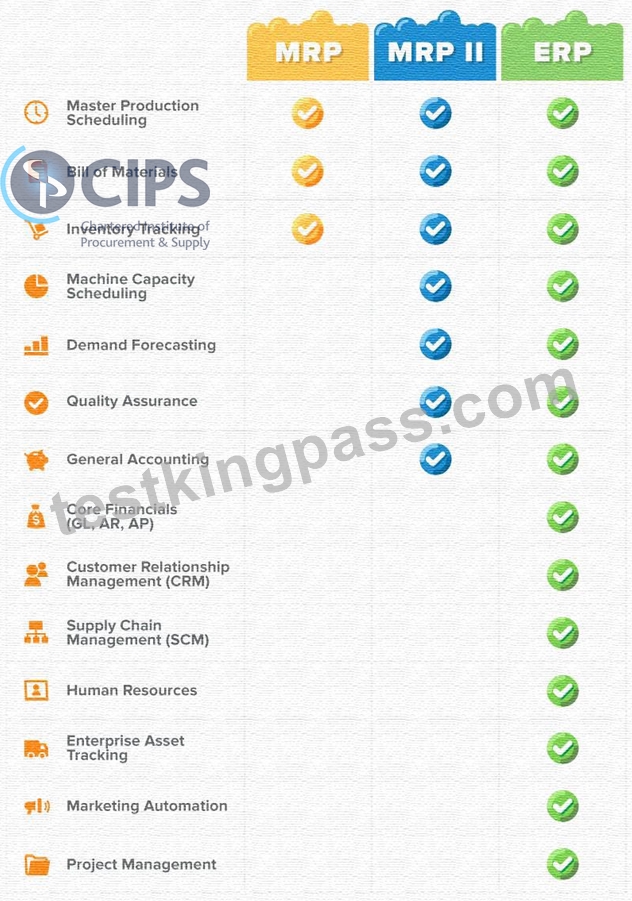
NEW QUESTION # 31
RFID uses radio frequencies for the purpose of identification and tracking of assets. Which of the following are disadvantages of using RFID? Select THREE that apply.
* RFID can be too expensive for many applications compared to other tracking and identification methods
* RFID tags have a limited amount of memory and are less effective than other product tracking systems
* It is difficult for an RFID reader to read the information where tags are installed in liquid or metal products
* Interference has been observed to take place in RFID systems when devices such as hand-held, portable, two-way radios are in use
* RFID provides a much less robust type of security compared to other forms of scanning systems
* RFID is a restriction in managing the updates of stocks during the transportation of products
- A. 1, 2, and 5
- B. 1, 3, and 4
- C. 2, 4, and 6
- D. 3, 5, and 6
Answer: B
Explanation:
RFID technology, while advanced, has several limitations:
* Cost: RFID can be expensive, particularly for smaller operations.
* Reading limitations with certain materials: Liquids and metals can interfere with RFID signals, limiting their effectiveness.
* Interference: Devices such as radios can disrupt RFID systems, reducing reliability.
In whole-life asset management, these disadvantages may affect the decision to implement RFID, especially in cost-sensitive or materials-sensitive applications.
NEW QUESTION # 32
A manager who is concerned about the environmental impact of packaging should do which of the following?
- A. Not use the packaging materials at all
- B. Purchase the packaging materials in bulk
- C. Adopt international environmental packaging standards
- D. Try to reduce the costs of packaging
Answer: C
Explanation:
In principle, use of any materials involves an environmental cost. Some packaging materials use a lot of natural resources and energy to produce. The journey taken by packaging from raw material to manufacturing and then to the initial user also incurs a 'carbon footprint'. The weight of packag-ing contributes to the fuel usage of vehicles while the volume used can add up to additional jour-neys or the use of larger vehicles. Finally, the reuse, return, disposal or recycling will also involve additional to the environmental cost.
In this question:
- 'Purchase
the packaging materials in bulk' may incur additional fuel and carbon footprint in delivering these materials
- 'Try to reduce the costs of packaging' may prompt the organisation to use less eco-friendly and cheap materials like polystyrene chips
- 'Not use the packaging materials at all' can increase the environmental performance of packag-ing activities, but it also harms the products to be delivered and may cause other environmental problems (i.e. spillage of toxic chemicals into the environment) So the correct answer should be: 'Adopt international environmental packaging standards'. The International Standards Organisation (ISO) has published several standards regarding packaging and environment, namely ISO 18601, ISO 18602, ISO 18603, ISO 18604, ISO 18605, ISO 18606.
Reference:
LO 1, AC 1.3
NEW QUESTION # 33
Which of the following costs can be classified as 'acquisition costs'?
* Invitation to tender and order processing costs
* Invoice processing and supplier selection costs
* Goods inspection and total ownership cost
* Total input costs and invoice processing cost
- A. 2 and 4 only
- B. 2 and 5 only
- C. 1 and 2 only
- D. 1 and 4 only
Answer: C
NEW QUESTION # 34
Which of the following are the different types of inventory that a manufacturing company usually has?
1. Work in progress
2. Economic order quantity
3. Raw materials
4. Finished goods
- A. 1, 2 and 4
- B. 1, 3 and 4
- C. 2, 3 and 4
- D. 2, 3 and 4
Answer: B
Explanation:
The normal breakdown in a manufacturing organisation would be raw materials, components, work in progress and finished goods.
Following are the different types of inventory: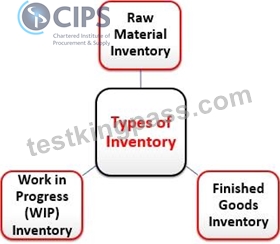
Raw materials are the basic materials that a manufacturing company buys from its suppliers, and that is used by the former to convert them into the final products by applying a set of manufacturing processes. For example, aluminum scrap is the raw material for a company that produces aluminum ingots. Flour is the raw material for a company that produces bread or pizza. Similarly, metal parts and ingots are the raw materials bought by a company that manufactures cars, and crude oil is the raw material for an oil refinery.
Work in progress inventory can also be called semi-finished goods. They are the raw materials that have been taken out of the raw materials store and are now undergoing the process of their conversion into the final products. These are the partly processed raw materials lying on the production floor. And they have also not reached the stage where they have been converted into the final product.
Finished goods are indeed the final products obtained after the application of the manufacturing processes on the raw materials and the semi-finished goods discussed above in the article. They are saleable, and their sale contributes fully to the revenue from the core operations of the company.
Reference:
- Types of Inventory
- CIPS study guide page 82-83
LO 2, AC 2.1
NEW QUESTION # 35
Lean principle focuses on eliminating eight types of waste. Waste in Lean manufacturing is defined as...?
- A. Rejection of material because of quality related problems
- B. Part of activity when operator is idle
- C. Non value-adding steps in a process
- D. Part of any activity which is inevitable
Answer: C
Explanation:
Lean thinking aims to remove wastes from work processes. Before diving into the 8 wastes, it is important to understand what waste is. Waste is any action or step in a process that does not add value to the customer. In other words, waste is any process that the customer does not want to pay for.
The original seven wastes (Muda) was developed by Taiichi Ohno, the Chief Engineer at Toyota, as part of the Toyota Production System (TPS). The seven wastes are Transportation, Inventory, Motion, Waiting, Overproduction, Overprocessing and Defects. They are often referred to by the acronym 'TIMWOOD'. The
8th waste of non-utilized talent or 'Skills' of workers was later introduced in the 1990s when the Toyota Production System was adopted in the Western world. As a result, the 8 wastes are commonly referred to as
'TIMWOODS'.
Source: The lean way
NEW QUESTION # 36
A manufacturer is making a plan for strategic safety stock. To do so, they must analyse the proba-bility of a stock out occurring and the cost impacts if it does. Which of the following are typical costs the manufacturer may incur in 'out of stock' event? Select TWO that apply.
- A. Costs of handling inventory
- B. Costs of approving the requisition
- C. Cost of equipment downtime
- D. Costs for qualifying suppliers
- E. Extra costs for urgent transportation
Answer: C,E
Explanation:
The costs of stockouts - the costs of being out of inventory - include:
- Loss of production output
- Costs of idle time and of fixed overheads spread over a reduced level of output
- Costs of any action taken to deal with the stockout, such as buying from another stockist at an enhanced price, switching production, obtaining substitute materials
- Loss of customer goodwill due to the inability to supply or late delivery.
(Procurement and Supply Chain management - 9th Edition, K. Lysons and B. Farrington, 2016) LO 2, AC 2.2
NEW QUESTION # 37
Removal or disposal of assets should depend on an assessment of which of the following? SelectTWOthat apply.
- A. Location of the equipment and accessibility
- B. Type of equipment and incorporated components
- C. Consumer demand for the product
- D. The current rate of interest for new equipment
- E. The total cost of the equipment
Answer: A,B
NEW QUESTION # 38
Which of the following code systems is commonly used by governments as a basis for their Cus-toms tariffs and for the collection of international trade statistics?
- A. The Harmonized Commodity Description and Coding System
- B. Global Trade Item Number
- C. The International Mobile Equipment Identity
- D. Global Location Number
Answer: A
Explanation:
The Harmonized Commodity Description and Coding System, also known as the Harmonized System (HS) of tariff nomenclature is an internationally standardized system of names and numbers to classify traded products. It came into effect in 1988 and has since been developed and maintained by the World Customs Organization (WCO) (formerly the Customs Co-operation Council), an independent intergovernmental organization based in Brussels, Belgium, with over 200 member countries.
The Global Trade Item Number (GTIN) is an identifier for trade items, developed by GS1. Such identifiers are used to look up product information in a database (often by entering the number through a barcode scanner pointed at an actual product) which may belong to a retailer, manufacturer, collector, researcher, or other entity.
The Global Location Number can be used by companies to identify their locations, giving them complete flexibility to identify any type or level of location required.
The International Mobile Equipment Identity (IMEI) is a number, usually unique, to identify 3GPP and iDEN mobile phones, as well as some satellite phones.
NEW QUESTION # 39
A manufacturer aims at increasing the service levels to 99% from 97% through expanding the safety stock.
Safety stock can be used to accommodate which of the following?
1. Variability of stock turn
2. Variability of holding costs
3. Variability of demand
4. Variability of lead time
- A. 1 and 3 only
- B. 3 and 4 only
- C. 2 and 4 only
- D. 1 and 2 only
Answer: B
Explanation:
Safety stock is also known as buffer stock. As this name suggests, this type of stock provides some kind of
'buffer', which means safety stock will help the business to reduce the shocks induced by volatile demand or disruption on the supply chain. In other words, safety stock will reduces the probability of stockouts. The following graph would explain the reason why an organisation should have safety stock:
Chart, histogram Description automatically generated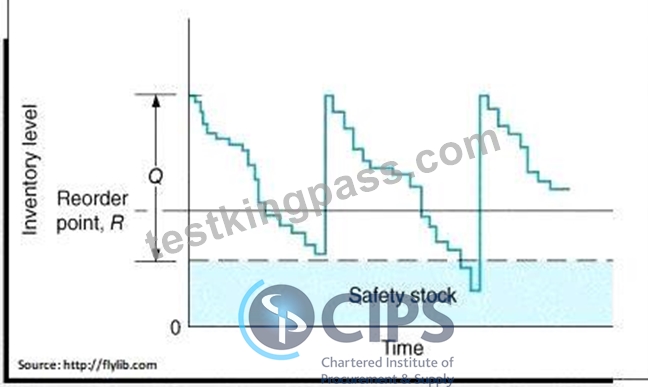
Figure 1: Safety stock graph
As it is only the buffer against uncertainty, safety stock level should be equal to the deviation of demand or replenishment time. Safety stock should be able to accommodate variance of demand and variance of lead time.
NEW QUESTION # 40
Zemora Clothing Inc. receives high-priced garments with devices hidden inside the lining to avoid possible fraudulent removal from the shop. These tags are activated upon arrival at stores, and security alerts are triggered if a garment is removed or taken out of the store without payment. Which of the following order tracking technology is used by this company?
- A. Electronic resource planning
- B. Radio frequency identification
- C. Electronic data interchange
- D. Bar coding system
Answer: B
Explanation:
Radio Frequency Identification (RFID) enables real-time tracking of items and is commonly used for security in retail to prevent theft. The tags are activated within a specified range, and alarms trigger when items exit without deactivation. RFID in asset management helps in tracking high-value items, ensuring security and reducing loss.
NEW QUESTION # 41
......
CIPS L4M7 (CIPS Whole Life Asset Management) Certification Exam is an advanced-level certification that is specifically designed for professionals who want to gain expertise in the field of asset management. CIPS Whole Life Asset Management certification exam is a globally recognized qualification, which provides professionals with the necessary knowledge and skills to manage assets throughout their entire life cycle. L4M7 exam covers a range of topics including asset identification, valuation, maintenance, replacement, and disposal. It also includes an understanding of the legal and regulatory requirements that govern asset management.
Genuine L4M7 Exam Dumps Free Demo Valid QA's: https://prepaway.testkingpass.com/L4M7-testking-dumps.html